The running order, and what I am shooting in each block
| Time | What is happening | What I am shooting |
|---|---|---|
| Doors minus 60 | Load-in, security sign-in, kit dropped at a base | Nothing yet. This block is pure logistics |
| Doors minus 45 | Room finished, staff still setting up | Empty room wide, table settings, signage, stage, sponsor boards |
| Doors minus 10 | Host briefing, staff line-up | Reception team, welcome desk, drinks poured |
| First hour | Arrivals and drinks | Candid handshakes, badges, step-and-repeat portraits |
| Hour two | Speeches, panel, keynote | Speaker mid-gesture, audience reaction, wide of the full room |
| Hour two to three | Awards or product reveal | Handshake at the marked spot, trophy held up, group of winners |
| Hour three | Dinner or networking | Table candids, detail shots, sponsor stands being used |
| Hour four onwards | Music, dancing, close | Dance floor at 1/200s, last-hour candids, room emptying |
| Same evening | Offload and quick edit | 15 to 20 images sent for the social team |
Before doors: the room nobody will ever see again
The forty-five minutes before guests arrive produce some of the most-used pictures of the whole night. A clean wide of the room as designed, the branding straight, the glasses unsmudged, the stage lit and empty. Marketing teams pull those frames for the following year’s sales deck and the venue asks for them too. Once two hundred people are in, that shot is gone.
This is also when I find the base. Somewhere to leave a case, ideally not the cloakroom, and a socket to charge from. It sounds trivial until you are carrying two bodies, a 24-70, a 70-200 and a flash for five hours with nowhere to put anything down.
Arrivals, roaming candids and the step-and-repeat
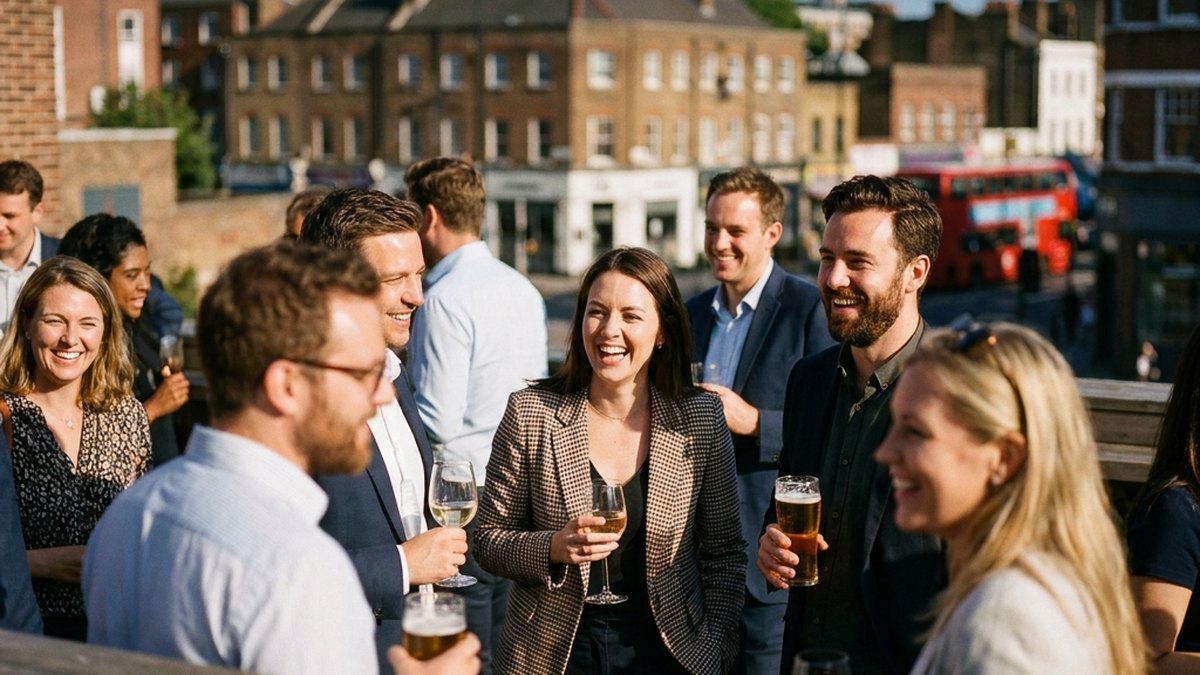
Arrivals is where the energy of the whole gallery is set. I work the room rather than standing in a corner with a long lens, because the pictures people actually share are close, warm and slightly imperfect. Groups of three or four, mid-laugh, glasses in hand. A gentle nod is usually all it takes to get a group to turn.
If you have a step-and-repeat backdrop, decide in advance whether it is staffed. An unstaffed branded wall gets used by about one guest in twenty. Put somebody friendly beside it with a clipboard and a queue forms. I would also light it properly rather than relying on the venue’s uplighters, which are almost always orange and almost always aimed at the ceiling.
Speeches and panels without blinding the speaker
Nothing marks out an amateur faster than a flash firing into a speaker’s eyes mid-sentence. For panels and keynotes I go flashless, push the ISO, and rely on a fast lens. Stage lighting is usually adequate and the pictures look like the room looked. I position early, get the wide before the audience settles, then move quietly along the side for the tighter frames.
Mixed lighting is the real problem here: tungsten uplighters behind, a huge LED screen washing blue across the speaker’s face, and a daylight window nobody thought to curtain. I shoot to fix one of those in the edit, not all three. Worth telling your AV team that a slide deck of pure white slides will blow out every face on the stage.
Awards: the ten seconds that go wrong
Awards need choreography or they produce nothing usable. Mark a spot with tape. Brief the host to say the winner’s name, hand the trophy, then hold, turn and face the camera for a count of three. Three seconds feels absurd on stage and is exactly enough. Without it you get the back of a head and a blurred handshake, every time.
If sponsors are presenting, get the sponsor logo in frame behind the handshake. That single picture is often the entire deliverable a sponsor is paying for, and it goes into their recap report the next morning.
The shot list I work from
- Empty room wide, plus two or three detail shots of the styling.
- Signage, sponsor boards and branded lanyards, clean and legible.
- Arrivals candids, at least twenty distinct groups.
- Every named VIP on the brief, at least twice, one of them usable as a portrait.
- Each speaker mid-gesture, plus an audience reaction shot from behind them.
- A full-room wide from the back during the busiest moment.
- Every award handshake at the marked spot, plus a group of all winners at the end.
- Dance floor or late-night candids, shot at 1/200s to freeze movement.
Consent, GDPR and the guests who would rather not
For anything with staff or members of the public in it, tell people photography is happening. A line on the invitation, a sign at the door and a word to the host covers most of it. Some organisers use a coloured lanyard or a sticker for anyone who prefers not to be photographed, which works well and takes about four seconds to explain to me at the start.
Corporate events add another layer. I have covered conferences where slide content was commercially sensitive and the brief was explicit: no screens in frame, ever. If that applies, put it in writing before the day rather than during it.
Same-day selection and the full gallery
The single most valuable thing I deliver is a small batch of 15 to 20 images sent while the event is still running or within a couple of hours of the end. Social teams need to post that night, and press deadlines do not wait for a full edit. The complete gallery follows within 48 hours, typically 150 to 250 images from three hours of coverage, in web-sized and full-resolution versions with vertical crops if you have asked for them.
The honest recommendation
Book three hours, not two. Two-hour bookings almost always mean arriving as the room fills, which loses the empty-room set and the arrivals warm-up, and the last twenty minutes get rushed. The step up in cost is small and the gallery is noticeably better. I would also skip a second photographer for anything under 150 guests in one room. It is the upsell I decline most often, and I would rather you spent that money on an extra hour.
Send a running order, a list of must-have people and one named contact who knows faces. That is all the brief needs. Rates and coverage options are on the event photography page, adding motion is covered under event videography, and if you are running a multi-room programme my conference photography guide goes deeper. I cover central London venues most weeks, so ask on the contact page and you’ll get a straight answer on how many hours your running order really needs, rather than a padded quote.