A launch is two shoots, not one
A product launch has two distinct pictures in it: the product on its own, and the product surrounded by people who came to see it. Most companies book the second one and assume the first happens by accident. It doesn’t. By the time guests arrive, the item on the table has fingerprints on it, three people stand in front of it, and the lighting the venue chose for atmosphere does the product no favours.
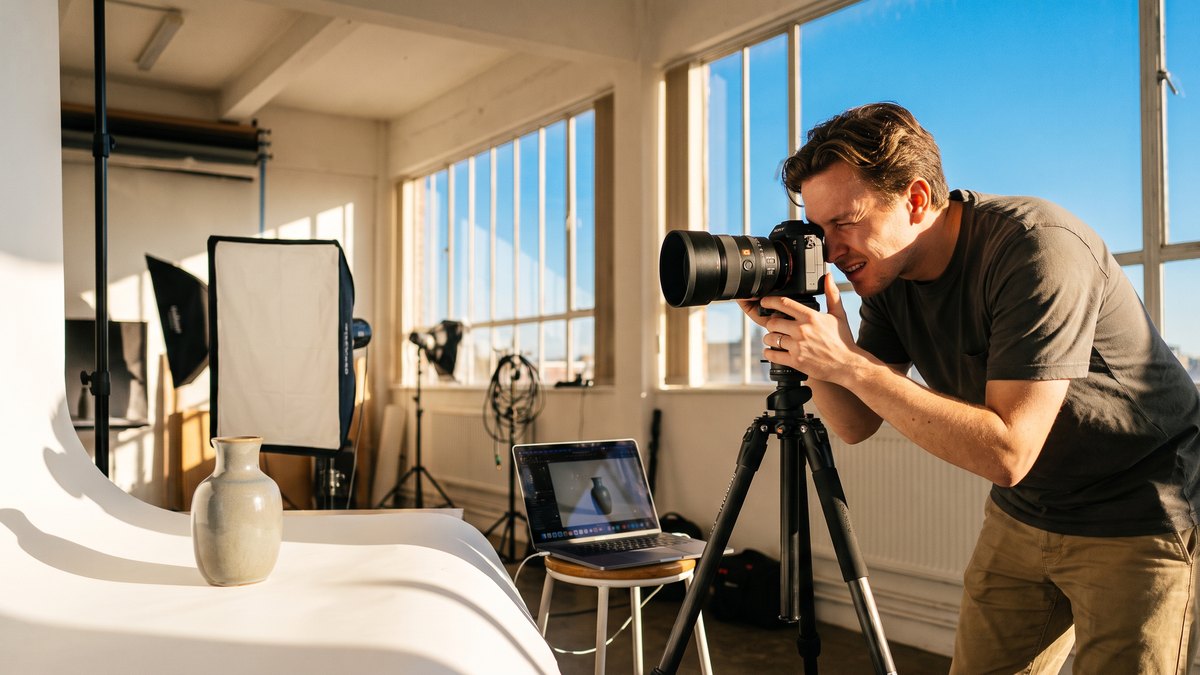
I treat these as separate jobs inside the same booking. The first is a controlled product shoot, done before doors open, on a tripod, with the room empty. The second is reportage: hands reaching for the product, the queue at the demo table, the founder mid-speech.
Book only the reportage half, which is what most companies do, and you get a lively gallery with not one clean image of the thing you actually launched. For how a general event runs, I have written up what an event photographer does hour by hour separately. This piece stays on launches, where the product is the subject and the party is the backdrop.
The hour before doors open
I ask for sixty minutes alone with the product before anyone arrives. That is a plinth or a table positioned near a window if the daylight is still decent, or a small flash bounced through an umbrella if it is not. The venue’s orange spotlights get switched off for this part; they flatter a room and ruin a product shot, turning white packaging the colour of weak tea.
Kit for the quiet hour
A 24-70 at f/8 covers most product angles without distortion. A fast 35mm for the wider room shot once the plinth is dressed. Tilt-shift for a tall product, when the verticals need to stay straight rather than leaning in. HDR bracketing for anything with reflective packaging, three frames blended rather than one flash fighting a mirror finish.
Fifteen frames from that hour end up in the press pack. I shot a launch in a Shoreditch railway arch last year with no clean wall in the whole space, brick everywhere, so we hung a plain backdrop from the ceiling rig and built the set in the one dry corner away from the bar. It isn’t glamorous. It works.
The same-night clock
Everything on launch night runs against a deadline that has nothing to do with the party. Journalists who have agreed to cover the launch usually file by 22:00. A beautiful set delivered on Thursday morning is worth less to them than a decent one sent at 20:00 the same night, so the schedule below is built around getting images out, not around the best possible frame of every moment.
| Time | What I am shooting | What gets sent | Who is waiting for it |
|---|---|---|---|
| 16:00 | Load-in, kit check, plinth build | Nothing yet | No one |
| 17:00 | The quiet-hour product set | Nothing yet | No one |
| 18:00 | Room dressed, lights focused, laptop set up in a side room | First edit pass starts | Me, ahead of doors |
| 19:00 | Doors open, first arrivals, drinks | Nothing yet, shooting only | No one |
| 19:40 | Guests three deep round the product | First batch, 10 images | The PR team, for social |
| 20:15 | Founder’s speech | Speech set, 8 to 10 frames | PR team and the founder |
| 21:00 | Demo table queue, hands on product | Second batch, 10 to 12 images | PR team, for press |
| 21:45 | Candid room shots, last light on the product set | Final press batch, 20 to 30 total | Journalists on deadline |
| 23:30 | Wrap, kit down | Everything else | Waits until morning |
That 21:45 batch is the one that matters most. If a founder wants video of the speech rather than stills, that is a different crew and booking; event videography from £500 covers a single camera on the stage with the audio feed, running alongside the photography rather than replacing it.
Hands, faces and the honest reaction shot
The pictures that sell the product afterwards are hands, not faces. Someone turning it over, someone reading the label, someone genuinely surprised by the weight of it. I shoot with a 70-200 from across the room for these so nobody performs for the camera, plus a fast 35mm in close for the demo table queue, where people are concentrating rather than posing.
There’s always one staged group shot everybody agrees to: founder, investors, the product, arranged and counted down. Fine, do it once, early, before the drinks kick in properly. But a photograph of six people pretending to be delighted is worth nothing next to one person’s actual face when they pick the thing up for the first time. I’d rather deliver forty honest frames than four hundred posed ones.
Through the reaction stretch of the evening I am watching for:
- Hands on the product, not just near it
- The demo table queue, shot from the side so faces read clearly
- Laughter or surprise, caught rather than asked for
- The founder watching the room rather than posing for it
Flash bounced off a low ceiling keeps this consistent once the room fills and the ambient light drops.
Press, embargo and licence
A publication will run a clean horizontal crop of the hero shot and not much else from a launch gallery. I deliver a 16:9 and a 1:1 of the strongest product frame at full print resolution, captioned with the product name and a credit line, because a picture editor will not chase you for missing information at 21:50.
Agree the licence before the night, not after. Who can use the images, for how long, and whether that covers paid social. I put this in writing as two lines in the booking confirmation; it takes thirty seconds and stops an argument in March about a photo still running in a Facebook advert.
The images keep working after the room empties. Same-night press coverage fades inside a week, but the quiet-hour product set and the strongest reaction shots carry a launch through the following month of social media content packages from £500, spaced out rather than dumped in one post the morning after.
Cost, crew and the awkward venue
Day rates
A booking starts at event photography from £350, which covers a two-hour evening slot with 60 to 80 edited images. A half evening, up to four hours including the quiet hour, runs £450 to £650 with 120 to 180 images. A full day with same-night press turnaround sits at £750 to £1,100, and that never drops below £350 whatever the guest count; a launch with twelve people still needs the same set-up hour.
A second photographer costs £250 to £400 for the day and earns its keep the moment a venue splits over two floors, which several East London spaces do. One of us stays with the product set, the other covers the room. Travel beyond Zone 3 adds £30, and delivery of the full stills set lands within 48 hours.
Getting kit into the venue
Parking near a City venue is close to impossible, and the Congestion Charge and ULEZ both apply on a weekday evening, so kit usually travels in on the Central line. A loading bay booked in advance saves real time; a venue with a lift and a wide corridor saves more, because carrying a plinth and light stands up a narrow period staircase eats into the quiet hour you paid for.
Shoot the product before anyone is allowed near it
Plenty of photographers will tell you the best product shots happen in the room, with the crowd’s energy feeding the picture. I don’t agree, not for most launches. Crowd energy makes a lovely reaction shot and a mediocre product shot, because the product is half-hidden by a shoulder and lit by whatever colour wash the DJ chose. The hero image, the one on the press release and the homepage, comes from the quiet hour, room empty, light under control.
One kind of product genuinely photographs better with people around it: anything meant to be worn or held, where scale matters more than surface detail. A jacket, a bag, a piece of tech held in one hand. For those I still shoot the clean set, but the strongest hero image often comes from someone wearing it naturally rather than the plinth. Furniture, packaging, drinks, anything with a finish that needs to read sharp, needs the empty room, every time.
Tell me the launch date, the venue postcode and whether you need same-night press images. I’ll come back within a working day, ready to book a launch night and confirm the crew for the schedule above.