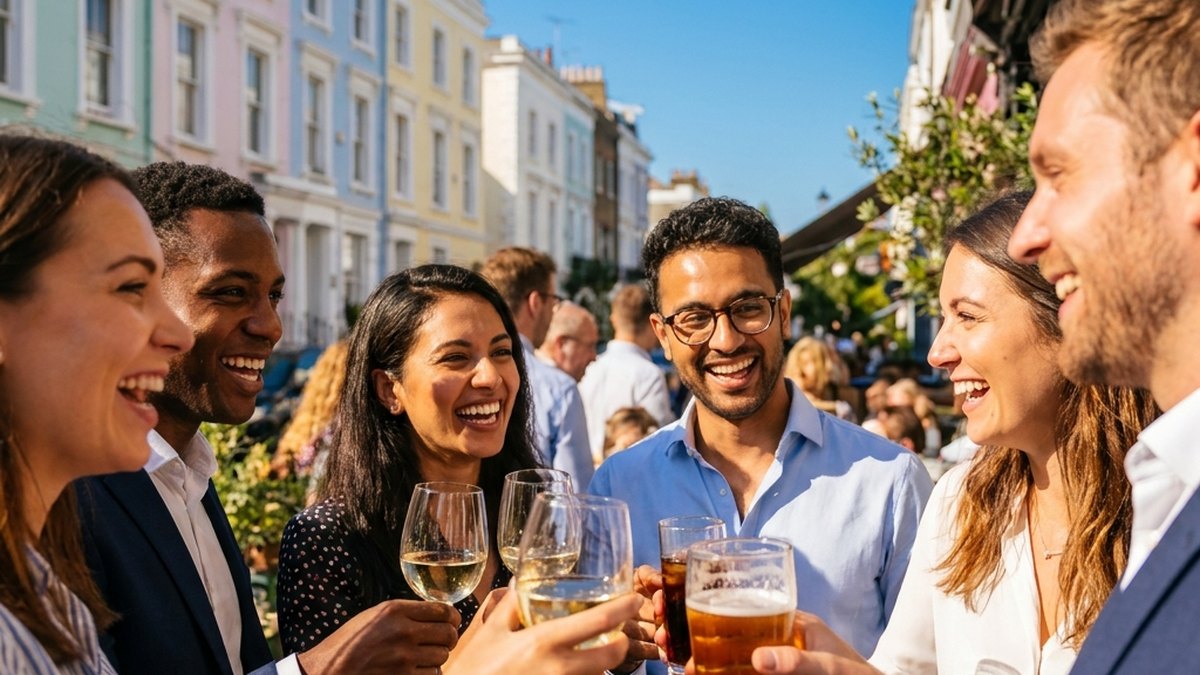
What the organiser wants and what the room wants
An organiser wants proof the event happened: sponsor logos in frame, a full room, someone from the board shaking hands with someone from the client side. The room wants none of that. Nobody arrives at a networking evening hoping to be caught mid-sentence with a glass of Prosecco and a lanyard askew. The two aims sit inside the same ninety minutes and mostly do not collide, but when they do, the room wins.
Most City and Mayfair bookings, the kind usually handled by a photographer covering Central London, treat sponsor visibility as the priority and atmosphere as an afterthought, which is back to front. A banner shot takes ten seconds. A room full of people who trust the photographer not to lurk is built over the first twenty minutes of the shoot, and it is the thing that makes every later frame usable.
I have turned up to launches briefed as “get the branding in every shot” and had to explain that a wall of logos with a stiff crowd in front of it is not proof of anything except a photographer standing too close. For the general shape of how a booking runs from arrival to wrap, see how an event shoot runs hour by hour. This piece stays narrower: what to point the camera at, and when to leave it hanging.
Raise the camera, or leave it
This is the actual job. Not “take good photos”, but decide, forty times an hour, whether this particular moment is worth interrupting.
| What is happening in front of me | Do I raise the camera | How I do it | Why the frame is worth having |
|---|---|---|---|
| Three-person huddle mid-sentence | Yes, once | One frame from six feet, no closer, no second attempt | Genuine conversation reads as genuine on a website |
| Someone alone on their phone | No | Walk past | Nobody wants to be the caption for “networking is hard” |
| Queue at the bar | Rarely | Only if it says something about turnout | A queue photo dates the gallery within a week |
| A handshake | Yes | Anticipate it, frame wide before hands meet | The one image every organiser asks for by name |
| Anyone eating | No | Wait for the fork to go down | Covered properly further down this article |
| The speaker at the lectern | Yes, several times | 70-200 from the back, vary the crop | The only formal record of the evening’s content |
| A card or QR exchange | Sometimes | Wide shot showing both faces, not just hands | Reads as a connection made without staging it |
| A group who ask to be photographed | Yes, immediately | Two frames, thank them, move on | They asked. Give them what they asked for and free the room |
| The sponsor banner | Once, early | Empty, then with a natural group passing it | Covers the brief without staging a line-up |
| The last twenty minutes | Barely | Wide room shots only, no faces close up | By then the room has stopped performing and shouldn’t be asked to start again |
Ten decisions, ten different answers. None of them is “photograph everything and sort it later”. That approach is how a two-hour event turns into 900 frames and a client wading through all of them to find the six they will actually use.
Kit that keeps the mood
One body, one lens, most of the night: a 35mm at f/1.8, ISO up around 3200, no flash. That combination lets me stand close enough to hear the conversation and far enough not to be part of it. A 24-70 comes out for room-wide shots and the banner; the 70-200 stays in the bag unless there is a lectern to cover from a distance.
Why I leave the flash off
Flash announces itself. The moment it fires, the three people mid-conversation remember there is a camera in the room, and the next fifteen minutes read stiffer for it. I still reach for it in a Farringdon basement with no windows and house lights doing nothing, because a dark, muddy frame helps nobody. Everywhere else, available light and a fast lens does the job without the cost.
Why I don’t carry a monopod or a second bag
A monopod reads as equipment, and equipment reads as a photographer working, which pulls attention. A second bag slung across the front does the same job in reverse — it marks me out as staff rather than someone who happens to be moving through the room with a camera. Small kit, one strap, hands free. That’s the whole strategy.
The first hour is the shoot
Arrivals, a full room, clean tables, everyone still holding a full glass: that is the set an organiser wants, and it exists for about sixty minutes. After that, glasses empty, jackets come off, name badges curl at the corners, and the room starts looking like the end of a long day rather than the start of a good one.
Book event photography from £350 for the two hours that cover arrival through to the point the room peaks, usually 60 to 90 minutes in, and the gallery looks like the event everyone hoped for. Book the same two hours from 19:30 to 21:30 instead of 18:30 to 20:30, and the whole set skews tired.
I’d argue against the later slot even when it suits a venue’s own schedule better. An organiser who insists on 19:30 usually gets talked round once they see what 20:00 does to a room lit by nothing but downlights and phone screens.
Consent without a lawyer
Most of this is handled before I lift the camera. A sign at registration saying photography is taking place covers the legal minimum; a different coloured lanyard for anyone who’d rather not appear covers the rest. I check for that colour without being told twice.
- Sign at the registration desk stating photography is in use
- A second lanyard colour for opt-outs, agreed with the organiser beforehand
- Taking someone out of the edited set on request, no argument needed
- Extra care with anyone who has clearly had a lot to drink, opt-out lanyard or not
None of this is legal advice, and I am not qualified to give it. Follow your own organisation’s photography policy, particularly if the guest list includes anyone under an NDA or a press restriction. When in doubt, ask the organiser on the night rather than guessing.
The headshot corner, and when it ruins the event
One light against a plain wall, a stool, and about 15 people an hour through it: a headshot corner is one of the easiest add-ons to a networking booking, and headshots from £150 covers it well as a standalone extra.
Here’s my opinion, stated plainly: running it during the only ninety minutes people have to talk to each other is a mistake. I have watched a headshot queue empty a room faster than last orders. Guests who came to meet people end up in a line staring at their phones, waiting to sit for a portrait they could have booked separately.
When it works
A headshot corner earns its place at breakfast events with a fixed 8am to 9am window, where people arrive knowing the portrait is part of the format, or right at the start of an evening before the room has filled. Bolted onto the middle of a drinks reception, it competes with the reason the event exists.
Nobody wants a photograph of themselves eating
Three categories of frame I delete without a second look: anyone mid-bite, anyone caught blinking with their mouth open mid-sentence, and the group shot where someone has raised their glass a half-second early. None of these tell an organiser anything true about the event, and all three end up as the frame a guest messages me directly, asking me to take down.
The exception is when the plate is the point. A canapé shot for a restaurant’s own marketing, styled and lit on purpose, earns its place. That is a different job with a different brief. At a networking event, food is fuel, not content, and the camera should treat it that way.
I’d rather hand over 65 strong images from 350 taken than 400 where a client has to do my editing for me. Fewer, better, chosen on purpose: that is the whole difference between a gallery that gets used and one that gets skimmed once and forgotten.
Tell me the date, the venue and the postcode, and I will book two hours around your first hour. I reply within one working day.