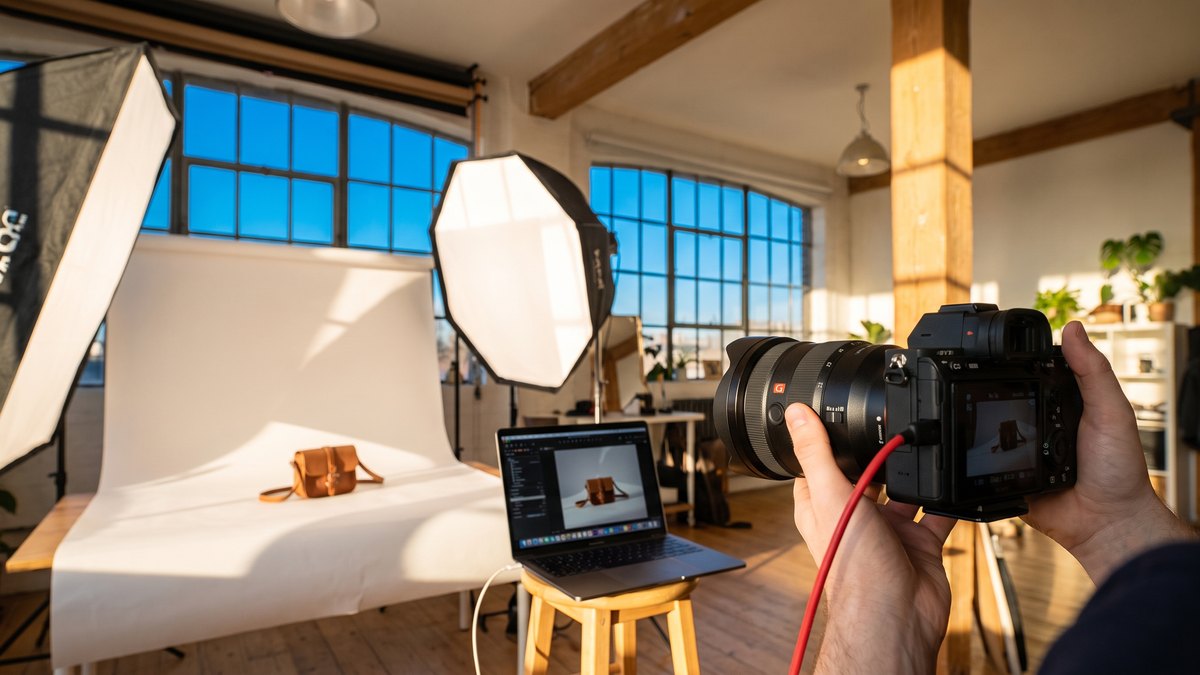
The six stages of an ecommerce shoot
An ecommerce shoot has six stages: planning, samples, shooting, retouching, file preparation and upload. Photography is stage three of six. It is usually the shortest stage and the cheapest one to put right if something has gone wrong. Get the light wrong on set and I can reshoot in twenty minutes. Get the shot list wrong before anyone picks up a camera, and you are paying for a second half day.
Most sellers assume they are booking a photographer. What they are actually booking is a small production line: someone to plan the count, receive the stock, shoot it, cut it out, name the files correctly and hand over something a web team can upload without touching a single filename. Miss one of those steps and the photography itself barely matters. That gap between expectation and reality is where most disputes start, weeks after delivery, when a listing looks fine on a phone but wrong on a laptop.
I have had briefs arrive with a beautiful mood board and no shot list, and briefs with a spreadsheet so precise I barely needed to speak on the day. The second kind finishes faster and cheaper, because the thinking happened before anyone switched a light on.
Who does what, and by when
Ecommerce shoots go wrong more often on the client side than mine. A responsibility split written down before the invoice goes out saves both of us a difficult phone call in week two.
| Task | You | Me | When it has to happen |
|---|---|---|---|
| Choosing which SKUs are in scope | ✓ | Before booking | |
| Couriering samples and arranging returns | ✓ | Three working days before the shoot | |
| Steaming and cleaning stock | ✓ | Morning of the shoot | |
| Signing off the shot list | ✓ | At least a week before | |
| Supplying a physical colour reference | ✓ | With the samples | |
| Art direction on the day | ✓ | On set | |
| Cut-outs and retouching | ✓ | After the shoot | |
| File naming and the CSV | ✓ | With delivery | |
| Uploading to the store | ✓ | After sign-off |
The two rows that cause the most delay are the shot list sign-off and the colour reference. Without a printed swatch or a known Pantone, screen colour is a guess, and a guess is what a returns queue is made of. That’s the pattern nine times out of ten.
Deciding how many images each SKU needs
The default is four images per SKU: front, back or reverse, a close-up on the detail that sells it, and one shot in scale, next to a hand or on a body. That covers most listings on Shopify, Etsy or Amazon without over-shooting.
When a fifth image earns its place
A fifth shot is worth the extra ten minutes for anything with a mechanism, a hidden feature, or a size that is hard to judge from a photo alone: a bag with an interior pocket, a lamp that needs to be seen switched on. Skip it for anything simple. A plain white mug does not need five angles, and I will say so on a call rather than quote for angles nobody asked for.
Colourways multiply faster than sellers expect
Thirty SKUs sounds like thirty product sessions. Add three colourways to each one and you’re shooting ninety variations, even though only the colour changes. I quote colourways as one full shoot plus a fixed rate per extra colour, because the lighting and angle are already set. It is a swap, not a reshoot. A catalogue growing by twenty SKUs a quarter is worth planning content month by month rather than booking one enormous day a year.
Samples, couriers and the day they eat
Stock arriving the morning of the shoot is normal, not a red flag. The problem is packaging that cannot be resealed, because then a sample becomes stock you cannot sell, and someone has to explain that to a supplier.
I have shot a delivery of forty with one item missing and reordered the shot list on the spot to work around it. Sensible sellers book the return courier before the shoot starts, not after, so the studio is not holding stock overnight it has no reason to hold. One Shoreditch client now sends a labelled sample box a week early, precisely because the first shoot taught them what late stock costs in wasted studio time.
My base runs between Shoreditch and Hackney Wick, with on-site work in a Park Royal unit when a client’s own stockroom makes more sense than moving boxes across town. Anyone shooting from East London should budget for ULEZ, and for the fact that a loading bay near Old Street gives you about twelve minutes before a warden takes an interest.
The same clock-watching turns up on other on-location work. Plating for restaurant and food photography from £400 runs on an identical short window before garnish wilts or condensation ruins a shot, and a steamed garment creases again within the hour just the same.
The sizes and crops your store needs
A Shopify listing wants square, roughly 2,000 by 2,000 pixels, sRGB, on white or transparent. That’s the file most sellers ask for, and the one most photographers deliver as the only file.
Square is the start, not the finish
The same shot has to leave the shoot in several shapes:
- 1:1 square, 2,000 pixels, sRGB: the listing image on Shopify, Amazon and most storefronts.
- 4:5 vertical: Instagram feed and email, where a square gets cropped short.
- 16:9 landscape: homepage and category banners, with clear space at one side for a headline.
- Cut-out on transparent PNG: anything that has to sit on a coloured background or inside a design.
A photographer who hands over one crop per shot has left you a full afternoon of cropping, or a designer’s invoice to pay for it.
I deliver all three crops from every hero shot as standard, since the extra export takes minutes and saves an argument later about why the banner image has someone’s elbow in it. Sellers running paid ads or email get the most from this: see social media content packages from £500 if you want crops built around a content calendar rather than a single shoot.
What comes back, and in what state
Files are named to the SKU, not to a generic sequence: SKU1234_front.jpg, not IMG_0091.jpg. That single habit is what lets a file drop straight into a store without anyone touching it by hand.
You get a contact sheet to sign off before final retouching starts. One round of amends is included, and turnaround is 48 hours for a small set or about five working days for a forty-SKU catalogue. Ask for it faster and it is possible, but it costs, because it means someone else’s job gets pushed back to cover yours. Rushing that stage rarely saves the time it costs, since a hurried retouch tends to come back for a second round anyway.
File naming is worth more than a better camera
The opinion I will defend: correct file naming and three crops per hero shot save a growing store more money than upgrading from a competent camera to an expensive one. Nobody’s conversion rate moved because a packshot was shot on a better sensor. It moved because the image loaded fast, matched the SKU, and did not need someone renaming two hundred files at midnight before a launch.
Where this stops being true: anything reflective, anything black, or jewellery. Chrome, glass and dark fabric are where a proper lighting setup and someone who has lit those surfaces before earns its cost back immediately. A cheap ring light will not rescue a bad shoot of a black watch strap. A watch with a mirrored case or a ring with facets rewards someone who has metered that reflection before, and no amount of file discipline substitutes for that experience.
Send me your SKU list and a launch date. I’ll come back with a shot count and a price within one working day.