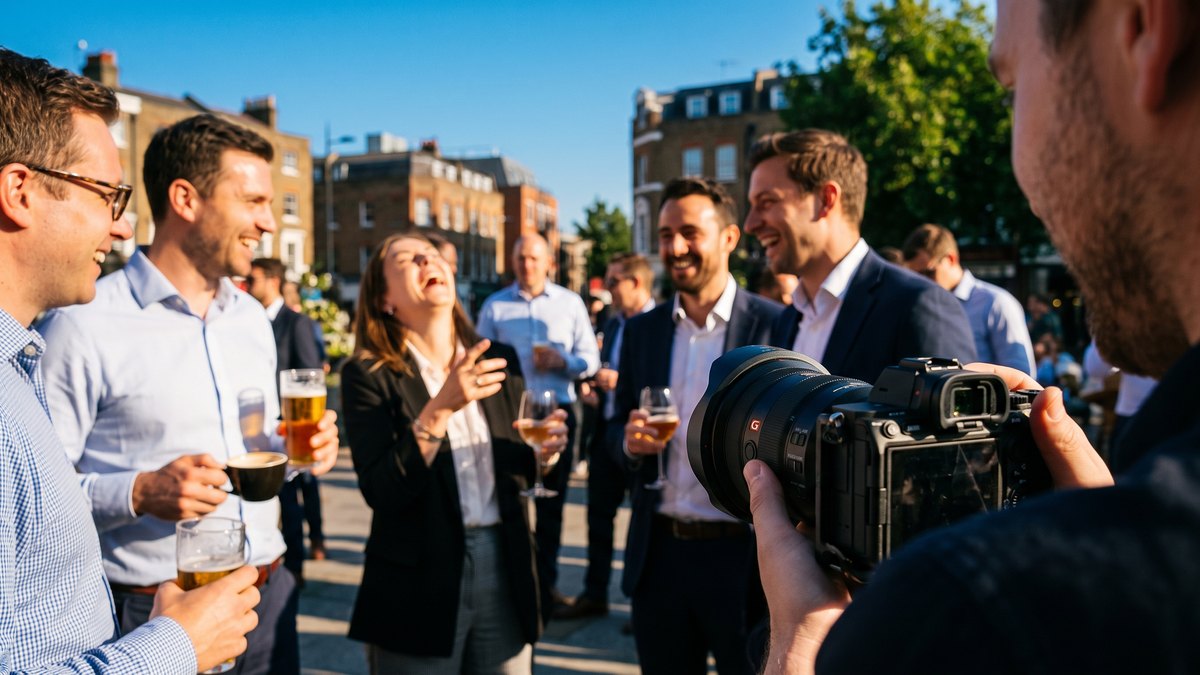
Where a charity’s photography money disappears
A charity books five hours of coverage for a gala at a livery hall near Bishopsgate, gets four hundred images back, and by March there is not a single shot the annual report can use. That is the pattern I see most often: plenty of hours bought, almost none of them planned around what actually gets reused.
September evenings compound it. Light is gone by seven, so a room booked from six until midnight is dark for most of that time, and a dark room photographs the same whether you have paid for two hours of it or six. Money spent on hours nobody needed is money not spent on a wider licence.
The fix is not more hours. It is fewer hours, planned around what a charity will reuse, paired with a licence that covers a full year of fundraising rather than one social post. I have written separately about what happens at an event shoot hour by hour; this piece stays on the money, the consent and what a shorter booking buys you.
Two hours, chosen carefully
Charities almost always ask for the whole evening. I’d steer most toward two hours instead, chosen around the moments that get reused rather than the moments that simply feel like an event.
The window that works
For a 19:00 start I would book 18:45 to 20:45: doors, arrivals, the room filling and the appeal itself, whether that is a paddle raise or a direct ask from the stage. The event photography from £350 booking covers precisely that window, at a livery hall in the City or a community centre in Peckham alike. Getting kit into a City venue means finding the loading bay before guests arrive, not after, and clearing it ahead of the Congestion Charge cut-off if I am driving.
What gets left out, on purpose
Dancing after 21:00 rarely makes an annual report. Neither does the raffle draw at half nine, when the room is two drinks past photogenic and every frame looks the same. If the appeal moment matters enough to film as well as shoot, the event videography from £500 booking runs alongside the stills, not instead of them.
Use, consent and what the licence must say
A wide licence does not cost anything extra from me. It just needs asking for in writing before the event, not chased down by email in February when the annual report is already overdue.
| How the charity will use the image | Image needed | Consent required | Cheapest way to get it |
|---|---|---|---|
| Annual report cover | A wide shot of a full, engaged room | Written consent from anyone identifiable in a printed publication | Ask on the door, note it against the guest list |
| Appeal email | A close, emotional frame from the appeal moment | General event consent, if stated clearly at booking | Cover it in the same door consent as the report |
| Social post | Any candid from the two hours | General event consent, checked against opt-outs | Same door consent, cross-checked before posting |
| Press release | A posed group with names attached | Named consent, ideally a signed release | Ask the press-facing group to sign on the night |
| Grant application | One or two strong documentary frames | Covered by general consent if grant use was named upfront | Mention grant use specifically when consent is taken |
| A beneficiary on a printed leaflet | A recognisable individual, not a crowd | Written, specific consent from the person or their guardian | Never assume general event consent covers this |
| Trustee portraits | Individual headshots, not candids | Each trustee’s own consent, taken separately | Book ten minutes before doors for a quick set |
| Sponsor thank-you | Sponsor logo or rep with the charity’s team | Consent from the sponsor’s own representative | Ask the sponsor’s contact, not the guest list |
| Next year’s invitation | A warm, generic scene, no single face prominent | General consent, since no one is singled out | Choose a wide, anonymous frame over a portrait |
Follow your own safeguarding policy on this, not a blog. That matters most with beneficiaries and anyone under eighteen, where consent needs to be specific rather than assumed, and recorded somewhere beyond a photographer’s memory. What I control is my terms on usage and delivery, which set out how long a licence runs and what counts as new use needing a new fee.
Photographing the people you exist for
I shoot beneficiaries at eye level, never looking down at them, and I ask twice: once to explain what the picture is for, once to check they are still happy once the camera is up. Anyone can say no at either point, no explanation needed, and nobody has to justify saying it.
The close-up of a crying child that some charities still use has aged badly, and I will not shoot it. It reads as pity rather than dignity now, and most donors spot the manipulation faster than the ask that follows it. I would rather hand a donor a picture of someone laughing at their own joke, or concentrating on something ordinary.
If someone asks to see the shot on the back of the camera, I show them. It costs ten seconds, and it is the difference between a photograph taken of someone and one taken with them.
The three shots the fundraising team always asks for afterwards
Three shots come up in almost every debrief email: the total reveal, the winning bid and the chief executive shaking hands with whoever wrote the biggest cheque. None of them need five hours of coverage, just the right ten minutes, spent in the right place.
- The total reveal: I stand front-of-room before the number goes up, not side-stage, so the figure and the faces land in the same frame, usually on the 24-70.
- The winning bid: I watch the auctioneer, not the paddles, because the tell is always the auctioneer’s hand a half-second before the gavel comes down.
- The handshake: I ask the chief executive’s team who the major donor is before doors open, so I am already close with the 70-200 rather than hunting the room afterwards.
None of this needs staging. It needs knowing where to stand ten minutes before it happens, which is planning rather than extra hours on the clock.
When a volunteer with a camera is enough
A volunteer with a decent mirrorless and a shot list genuinely covers a quiz night or a fun run well. Give them registration, the start, the winners and a few candid smiles to get, and they will come back with something usable for a newsletter or a social post.
Where it falls apart is low light, speeches and anything destined for print. An entry-level camera hunts for focus on a dim stage, and a newsletter-resolution file looks soft the moment it is stretched across a pull-up banner or a report cover. That is the point at which a volunteer’s goodwill stops being the cheaper option, however keen they are.
Why I stopped shooting charity galas for free
I used to shoot one charity gala a year for free, on the basis that it was good for the portfolio and good for the cause. It wasn’t especially good for either. Free work gets treated as an extra: booked last, briefed worst, cancelled first if the room feels tight on volunteers that week.
Now I offer a genuinely reduced day rate for registered charities rather than a free one, and I ask for the same two-hour booking and the same written consent I would want from a paying corporate client. It gets treated as a real booking because it is one, on both sides.
Plenty of photographers I respect still shoot galas for free and are glad they do. If it works for you and the charity, I have no argument with it. It stopped working for me once I noticed the free bookings were always the ones nobody had planned properly.
Send the date, the venue and roughly how many guests are coming, then tell me what the budget is. I will come back within one working day with a two-hour price and what it covers.