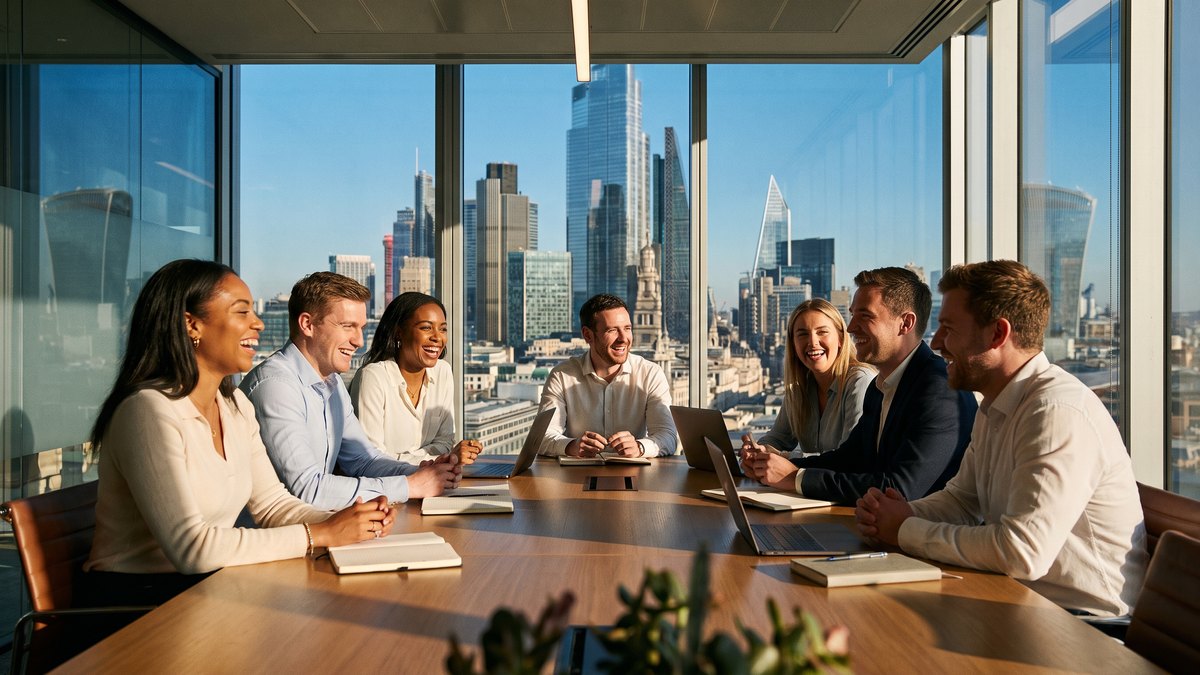
What a full day produces
A full business photoshoot day in London runs 08:00 to 16:30 and produces, on a good run, 40 to 80 edited images. That includes headshots for 15 to 25 people, one team shot, around 20 candid working frames and a full set of interiors, plus vertical crops pulled for social afterwards.
Not everything earns its place. In my experience, roughly a third of the candid frames never get used: someone mid-blink, a lanyard the wrong way round, a screen showing something it should not. The headshots and the empty-room interiors are what last. Candids date fastest, because desks change and people move on within a year.
The count depends on headcount more than anything else. A 15-person office and a 25-person office need roughly the same setup time, so the difference shows up almost entirely in the headshot slots, not the candids or the interiors, which stay fixed whatever the team size.
A half day covers less ground. Corporate photography from £250 buys four hours and one location, with a shorter list. A full day at this volume starts from branding photography from £600, and that’s the number worth budgeting from, not the headline day rate.
Nine decisions to make before the day
The expensive mistakes on a shoot day are almost always made three weeks earlier, not on the day itself. Sign off these nine before anyone books a slot. If the job is closer to a personal-brand session than a company day, how to brief a branding photographer covers the same ground from a different angle.
Why the deadlines matter
A shot list agreed on the morning means asking someone to make decisions while forty people wait outside a boardroom. It is not fair on them, and it shows in the pictures. Everything below gets easier the earlier it is settled.
| Decision | Who makes it | Deadline before the shoot | What it costs to change late |
|---|---|---|---|
| Shot list sign-off | Marketing lead | 2 weeks | Reshoot risk on the day |
| Location | Office manager | 3 weeks | Access delays, lost morning light |
| Wardrobe brief | HR or team lead | 1 week | Mismatched colours across headshots |
| Which staff appear | Department heads | 1 week | Reshuffled schedule on the day |
| Clients or public appear | Legal or comms | 2 weeks | Consent forms chased on site |
| Brand colours and props | Marketing | 1 week | Clashing backdrops, wasted setup time |
| Usage licence | Marketing director | 2 weeks | Renegotiation, often an extra fee |
| Retouching level | Marketing | 1 week | Slower turnaround, extra cost per image |
| Delivery format and file naming | IT or marketing | 1 week | Manual renaming after delivery |
None of this is bureaucracy for its own sake. Every row on that table has a version I have seen go wrong: a shot list rewritten in the lift on the way up, a wardrobe brief nobody read. The deadline column exists because I have watched each one slip.
08:00 to 16:30, hour by hour
Morning
08:00 is access and setup: kit off the Central line, no parking near most City offices so flight cases come in on a trolley, lights up before anyone arrives. Headshots start at 09:00 in 15-minute slots, two looks and a couple of expressions each, done.
Most guides say shoot the team photo first thing, while everyone’s fresh. I disagree. Fresh at nine usually means half the floor hasn’t arrived yet. The team shot goes at 11:00 instead, the only hour when a company’s whole floor is reliably in the building, after the morning stand-up and before anyone has slipped out for lunch.
Afternoon
Candids run through to 12:30, then there is a reset while the building empties for lunch. Leadership portraits go at 13:30, when directors are back and calmer than they were at nine. Empty interiors proper start at 15:00, and exterior and street shots close the day at 16:00, timed for the light before it drops.
If the brief also includes a corporate video shoot day running alongside stills, video works the same slots rather than repeating them. That is the only way both come in on schedule without the day running long.
The wardrobe conversation nobody has
One email a week ahead beats a mood board handed round on the morning. Plain over pattern, always: fine stripes and small checks flicker under studio lights and read worse on screen than they do in the room. Layers help too. A jacket that comes off for the headshot and goes back on for the candids gives two looks from one outfit.
There is always one person who turns up in a branded polo shirt nobody asked for, and one who has forgotten the brief and arrives in gym kit. On a shoot near Liverpool Street last autumn, three people turned up in the same red jumper. I keep a spare shirt in my kit bag for exactly this reason. It’s saved more shoots than any lens I own.
The half of the day with nobody in it
Empty desks. A meeting room with the door left open. Details on a shelf: an award, a plant, a stack of the product. The street outside. The entrance at 16:15, lights on, glass catching the last of the afternoon. None of it needs a person in frame, and all of it gets reused for years.
Staff turn over. A team shot from March reads wrong by September if four people have left, which happens more often than clients expect. A well-lit, empty boardroom does not quit, does not change job title and does not need re-briefing. I’d argue this half of the gallery earns its place in the budget more reliably than the headshots do, even though nobody asks about it during the planning call.
- Reception desk, no one behind it
- A corridor with natural light
- Product or signage on a clean surface
- The building frontage, straight on
Licence, and the question that gets asked too late
Internal use, the website and a press pack are usually covered as standard. Paid advertising and out-of-home use are not, and that is the question that gets asked after the invoice is paid, once the images are already sitting in a media plan.
Ask about it at the brief stage, not delivery. An extended licence for paid social and display ads typically adds a fixed fee on top of the shoot cost, agreed before the day rather than negotiated after. Marketing usually pays it, not procurement, because procurement rarely knows the images exist until someone wants to boost a post with one.
I had a client ring back four months after a shoot near Moorgate, wanting the same headshot set for a bus-stop advertising campaign. The internal licence did not cover it, so we agreed the extra fee by email and moved on. A quick conversation, but one that could have happened before the invoice went out.
Half the day should have nobody in front of the camera
Companies plan a shoot day around people, then discover at 15:00 there is no image of the space, the product or the street. By then there’s twenty minutes of usable light left and a full afternoon of headshots already banked. I’d rather flip that ratio from the start of the brief.
People-free frames outlast staff turnover, rebrands and office moves in a way headshots never do. The exception is a genuinely small company, six or eight people where the founders are the brand. There, the reverse holds. Skip the empty desks and spend the day on the people, because at that size the faces are the product.
Tell me the date, the postcode and the headcount, and I’ll send back a running order within one working day. From there we can book a shoot day and sort the wardrobe email together.