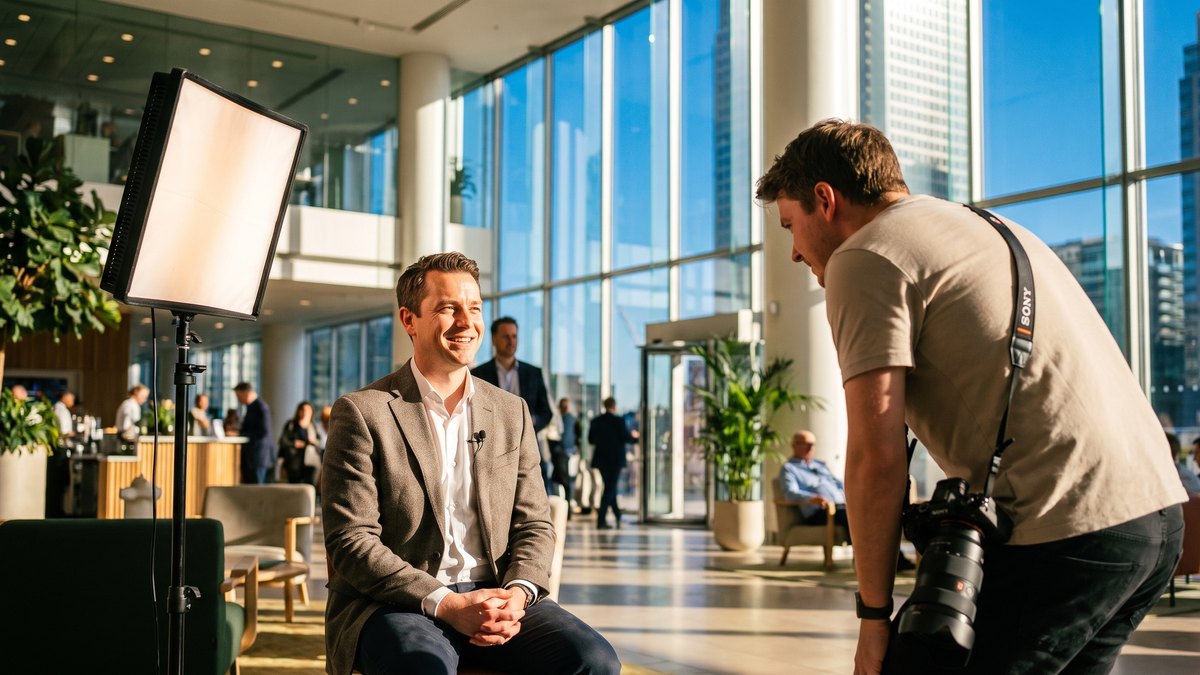
The day at a glance
| Time | What is happening | What you need to provide |
|---|---|---|
| 07:30 | Load-in via the loading bay or side entrance, kit to the floor | Access booked, security cleared, one named contact on site |
| 08:00 to 09:30 | Lighting, camera and sound setup in the interview room | A quiet room held empty, blinds that work, a spare power socket |
| 09:30 | Test frame, sound check, first speaker mic’d up | Speaker one arriving ten minutes early |
| 09:45 to 12:45 | Four to six interviews, 25 to 35 minutes each in the chair | A running order and someone chasing the next speaker |
| 12:45 to 13:30 | Lunch, card offload, backup to a second drive | Nothing, genuinely |
| 13:30 to 15:45 | B-roll: desks, meetings, corridors, product, exteriors | Staff briefed, desks tidied, screens showing safe content |
| 15:45 to 16:15 | Pickups, cutaways, any reshoot flagged during the morning | One decision-maker still on site |
| 16:15 to 17:00 | Derig, second backup, kit out | Lift access again, which people always forget |
07:30: the loading bay, the lift and the front desk
Nobody budgets for this and it is where days go wrong. A corporate video kit is three or four cases, two light stands and a tripod. That does not go through a revolving door, so somebody needs to open the accessible entrance. Loading bays in the City run on twenty-minute unloading windows and a booking reference, and once the window closes the van has to move because there is no parking anywhere near. Add the Congestion Charge and ULEZ before a single frame exists.
What helps: send the crew a building contact with a mobile number, book the goods lift, and get names onto the security list 48 hours ahead. Fifteen minutes of admin the week before buys back an hour on the day.
08:00: lighting and sound in a room that fights you
Most offices are a mess of colour temperatures. Tungsten uplighters in the breakout area, cold LED panels overhead, daylight from a wall of glass, and a screen behind the speaker throwing blue across one cheek. Sorting that is the bulk of setup. Usually it means killing the overheads in one corner, gelling a key light to match the window, and putting the speaker’s back to something with depth rather than a blank wall.
Sound decides whether the video looks professional more than the camera does. A lapel mic on the speaker, a shotgun mic overhead as backup, and a war against air conditioning, lift dings and the espresso machine two doors down. I will ask you to turn the air con off in that one room for twenty minutes. It is not fussiness, it is the difference between a clean interview and one that hums.
09:45: interviews, and how to make them usable
Each speaker gets 25 to 35 minutes in the chair, which yields perhaps 90 usable seconds. That ratio surprises people every time.
What to tell your speakers
- Answer in full sentences that restate the question, because the question is not in the edit.
- Look at me, not the lens, unless we have agreed otherwise.
- Stumbles are fine. Stop, breathe, start the sentence again. Nobody sees it.
- Solid mid-tone colours. No fine stripes, no logos, no jangling jewellery near the mic.
- You will be asked the same thing twice in different words. That is deliberate, not a trap.
Autocue: usually not
Clients ask for autocue more than they need it. It suits a scripted chief executive statement of 60 to 90 seconds, and it kills everything else stone dead. Read speech has a rhythm people hear instantly, even if they cannot name it. For culture films, recruitment content and customer stories I would strongly argue for prepared bullet points and a conversation instead. If you do want autocue, budget an extra 30 minutes for setup and rehearsal per speaker, and write for the ear rather than the page.
13:30: b-roll, the part that makes it watchable
B-roll is everything that is not a talking head: hands on keyboards, a meeting through a glass partition, someone walking out of the lift, the street outside, the sign in reception. Cut over interview audio, it turns a block of talking into something people finish. Budget two hours minimum. Anyone promising a polished film off 20 minutes of cutaways has not edited one.
Two practical asks. Tidy the desks you want filmed, and put safe content on the screens. I have had to reframe an entire sequence in a Shoreditch fintech office because every monitor showed live customer data. And brief staff the day before that filming is happening, so nobody is ambushed and anyone who prefers not to appear can say so quietly.
What actually delays a day
- Building access and lift bookings. Routinely 45 to 60 minutes if not arranged.
- A speaker who runs late or arrives straight from another meeting with no brief.
- Sign-off by committee. Three people disagreeing on set about the message costs an hour.
- Air conditioning nobody can switch off, forcing a room change mid-morning.
- Scope creep. Can we also grab a quick piece for the awards entry, asked at 15:30.
The client’s job on the day
Smaller than you would think, and quite specific. One named decision-maker who can approve a frame without a phone call. One person shepherding speakers so the next one is outside the door when the last stands up. Somewhere to leave cases. Tea would be nice. Everything else is mine, and a client hovering behind the monitor giving notes between takes tends to make speakers more nervous, not less.
After the day, the edit runs on its own clock. A first cut in five to seven working days, one consolidated round of feedback from you, then final delivery with subtitles and the platform versions. Most projects land two to three weeks from the shoot.
Full day or half day, decided
Book a full day rather than a half day if you have more than two interviews. Half days on video are false economy: the setup cost is identical, so you pay most of the money for a fraction of the material, and you always end up wishing you had the b-roll. If budget is tight, cut the number of speakers instead and give the remaining ones better preparation. Three well-briefed people beat six rushed ones every time.
I would also shoot stills on the same visit. The lighting is already up and the people are already there, so adding corporate photography to a video day costs a fraction of a separate booking and gives your team something to post while the edit is still running. The same logic applies to vertical social cuts, which are far cheaper to plan for on the day than to retrofit afterwards.
If you are weighing up a shoot at your east London office or anywhere else in the city, the corporate video page has the rates, and a short brief sent to my contact page gets you a realistic schedule rather than an optimistic one.