The main image rules in plain terms
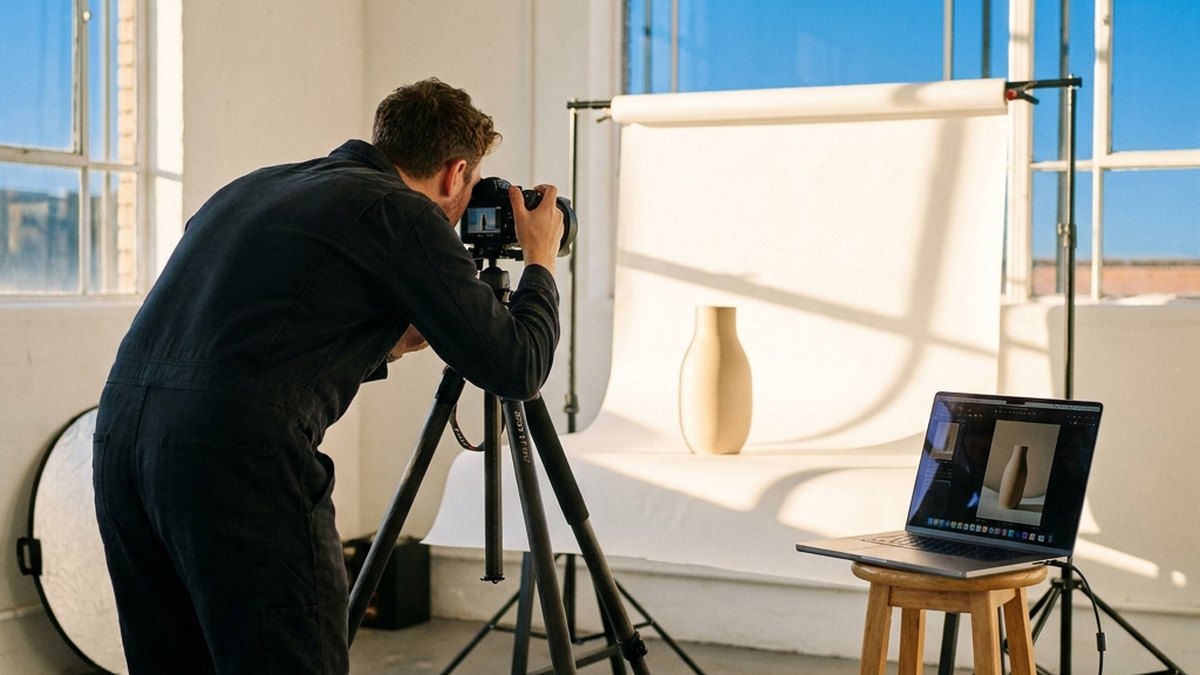
The main image on an Amazon listing sits on pure white: RGB 255,255,255, not something that merely looks white on a laptop but measures 255 in Photoshop’s info panel. That distinction catches out more sellers than any other rule here. The product needs to fill roughly 85% of the frame, not sit in a sea of white, and not be cropped so tight a corner falls out of shot.
The rest of the main-image specification is a short checklist. Amazon suppresses a listing rather than let a grey box stand in for a real product.
- No text, logos, watermarks or borders
- No props, and no second product creeping in from the SKU you shot before it
- No nudity, and no placeholder graphic while stock is in transit
- The whole item in frame and in focus, not soft from shooting handheld at f/2.8 to save on lighting
The image slots and what each one is for
Most categories on Amazon UK allow up to nine images. Most sellers use three. That gap is the whole argument here: the specification is a floor, not a finish line, and the slots above the minimum are where a listing starts selling rather than merely qualifying.
| Image slot | What it is for | Requirement | Common reason it gets rejected or ignored |
|---|---|---|---|
| Main image | The thumbnail in search results and the hero on the listing | Pure white background, product filling around 85% of frame, no text or props | Off-white background, product too small, a shadow read as a prop |
| Secondary angles | Showing the product from the side, back or in detail | Consistent lighting and framing with the main image | Sellers reuse the main image cropped differently instead of shooting a genuine second angle |
| Scale or size-in-hand | Answering how big something is, really | A believable human hand or familiar object for scale | Skipped entirely, or a hand so posed it looks like stock photography |
| Infographic | Callouts on dimensions, materials or what’s included | Text kept off the main image and moved here instead | Treated as an afterthought made in five minutes, not a shoot |
| Lifestyle | The product in use, in a real setting | Context matching how the buyer will use it | Left out because it needs a set, not just a light tent |
| Packaging and box contents | Reducing returns from buyers unsure what they’re getting | Every included item laid out and visible | Assumed unnecessary for small items, then the returns say otherwise |
| A+ content module | Extended brand content below the fold, for enrolled brands | Brand Registry enrolment and separate module specs | Confused with the standard nine-image gallery, which it is not |
| Video | Motion and sound where a still can’t do the job | Short, product-led, working with the sound off | Treated as optional polish rather than a slot with its own job |
The video slot costs almost nothing on a day already booked
Video is the slot I get asked about least and think about most. A thirty-second clip shot the same day as the packshots costs very little once the lighting is up and the product is on the table. Ask whether the same afternoon can also cover social content packages for Instagram or TikTok, rather than booking the Amazon video separately. I have written more on getting more from one shoot.
File and pixel specifications that matter
1,600 pixels on the longest side is the practical minimum for zoom to work on the product page, and the point below which I would not submit a file. Zoom is one of the few free features that helps close a sale, and a 1,500-pixel image leaves it switched off.
I shoot at 3,000 pixels square as standard, comfortably above the requirement, which leaves room to crop for the infographic or a second listing without shooting again.
sRGB, not Adobe RGB. JPEG is the safe upload format even if you retouch in a wider colour space; converting late and checking afterwards catches the odd shift in whites. Square framing is expected for the main image, even where the product is tall or wide, which is why that decision doesn’t wait for the edit.
Category exceptions that catch sellers out
Shoes are usually photographed as a single shoe at an angle, not a matched pair square-on. Clothing splits by category: on a model for some, flat or on a mannequin for others. Food packaging generally needs the ingredients panel visible somewhere in the set.
Books and media have their own cover conventions that don’t map onto general product rules at all. Every one of these exceptions fits inside the same broad framework, but the current Seller Central style guide for your specific category is the place to check before a shoot, not a general guide like this one.
What gets an image rejected, and what quietly loses sales
Rejection is the easy failure to spot, because Amazon tells you about it. An off-white background sitting at 248 rather than 255 gets flagged. So does a product occupying half the frame, a watermark, and a blurred crop where someone has zoomed into a wider shot rather than reshooting. That last one is the most common reason a rushed batch bounces back.
A compliant gallery can still answer nothing
The quieter failure is an image that passes every check and tells a buyer nothing. Correct white, correct pixel size, not one question answered. No scale. No sense of texture or weight. No context for use.
I’d argue that costs a seller more over a year than a batch of rejected uploads ever does. A rejection gets fixed; a technically perfect, boring gallery sits there converting badly with nobody flagging it.
Shooting for Amazon from London
A half day from £400 covers roughly fifteen to twenty-five SKUs with a main image plus two secondaries each, enough for a small catalogue update without a week-long project. It is the same rate as food and product photography from £400, and the kit doesn’t much care whether the thing on the table is a ready meal or a phone case.
Samples travel better than lighting stands do
Most sellers courier samples to my studio in East London rather than have me travel to a warehouse: cheaper, faster, and the lighting stays consistent set to set. For bulkier stock I shoot on site, often a unit out towards Park Royal or Barking.
Both sit inside the ULEZ boundary, a cost to factor into the quote, and neither has parking that lets you unload a car full of stands in twenty minutes. On a set this size I deliver within 48 hours, so the listing can go live the same week the samples arrived.
The slot most sellers waste
It’s the second secondary angle. Slot three, typically: after the main image and one genuine alternate view, most galleries repeat the product from a slightly different angle on the same white background. It adds almost nothing a buyer did not already see in slot one.
I would drop it and put a scale or size-in-hand shot there instead, or an infographic if the product has dimensions worth calling out. A hand holding the product, or the product beside a set of keys, answers the question that drives returns: is this bigger or smaller than I pictured.
That is not a popular view among sellers told nine white-background images is the goal. Nine compliant images is not the goal. Nine images that each do a different job is.
Send your ASIN list with a note of which slots are already filled. I’ll come back within one working day with a price and the order I would shoot them in.