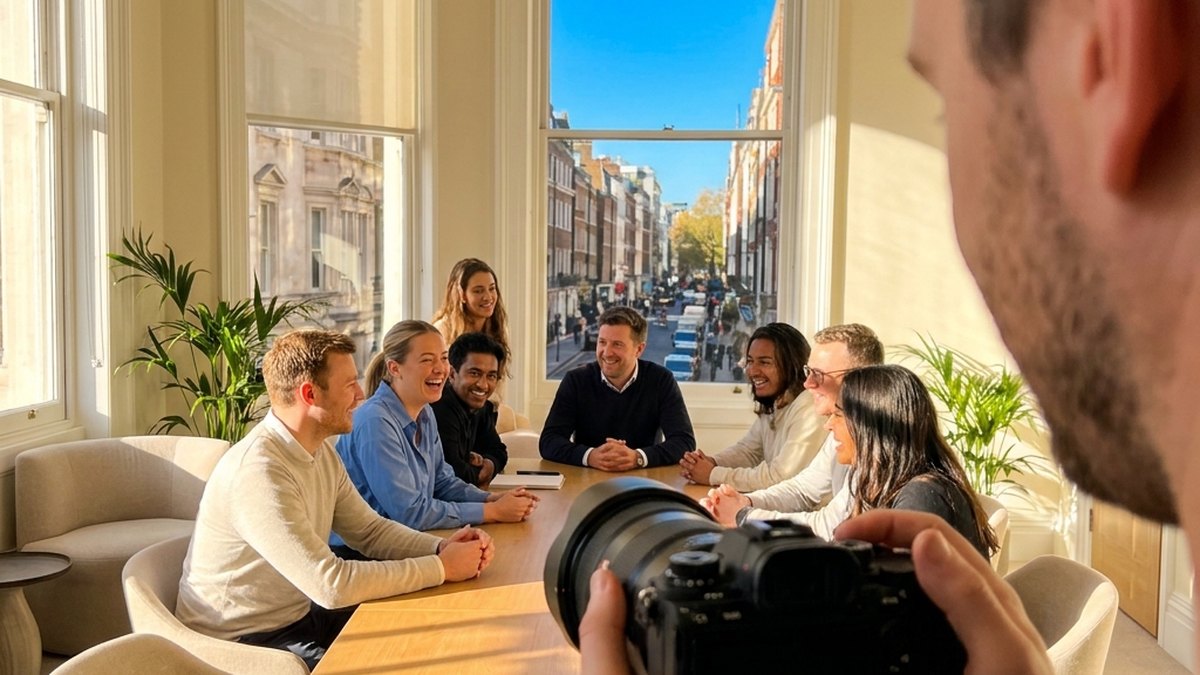
Why team photos fail
Four things wreck a team photo, and none of them are about smiling. A magnolia wall two feet behind the group flattens everyone into one plane, so the image looks like a passport photo stretched to forty people. A ceiling under 2.4 metres crops the back row’s hair whatever angle you shoot from. A single flash bolted to the camera lights the front row and drops the back row into shadow.
The fourth cause is timing. Told to smile on a count of three, forty adults never land together. Someone blinks. Someone is mid-laugh at a joke you didn’t hear. Someone is reading a message about the meeting they are missing right now. I would rather shoot on a loose count and keep the frame nobody was watching for.
By head count
If you only need one image of the team, book it as its own job. That is corporate photography from £250, not a favour tacked onto the end of a headshot day when everyone is tired and the light has gone.
Below that, the numbers change what is possible. This is what I plan around, in metres rather than adjectives:
| Team size | Formation that works | Space and ceiling height needed | Minutes on the day | What goes wrong |
|---|---|---|---|---|
| 4 | Single row or a loose huddle | 2m x 2m clear floor, any ceiling | 5 | Nothing much: the risk is boredom, not logistics |
| 8 | Two rows of four, gentle stagger | 3m wide x 3m deep, 2.4m ceiling minimum | 8 | Back row heads clipped by a low ceiling or a light fitting |
| 12 | Two rows, staggered, or a shallow arc | 4m wide x 3m deep, 2.6m ceiling | 10 | Front shoes and back faces compete for the same lens height |
| 20 | Three rows on a staircase or a step | 5m wide, needs a step or slope for the back row | 15 | Flat floor means the back three rows are just hair |
| 35 | Wide staircase, mezzanine rail, or three rows plus a kneeling front | 8m wide x 4m deep, 3m+ ceiling or open stairwell | 20 | Depth of field falls apart if the lens sits too close; back row goes soft |
| 60 | Open staircase across two flights, raked seating, or a terrace split into blocks | Genuine elevation needed: a stairwell or raked seating, 4m+ vertical rise | 30 | Wind on a terrace, or a stairwell too narrow to frame everyone |
| 100 or more | Blocks on tiered ground, or a wide exterior shot from well back | 12m+ width, open ground, room to stand 15-20m back | 40 | Faces become dots without real height difference between rows |
The jump from 20 to 35 is where most bookings go wrong. Clients picture the same doorway that worked for the marketing team and forget the whole company does not fit through it. Above 35, I am looking for elevation before anything else: a landing, a half-flight of stairs, a rake in the seating.
Most of these bookings arrive attached to a headshot day, and that is usually the sensible order: portraits first while everyone’s fresh, group shot last once people are already gathered. If that’s the plan, it helps to know how many headshots I can shoot in an hour before you fix the schedule, and that headshots from £150 sit on a completely separate price list to the group shot.
Where in London you can put forty people
An open staircase is the best free resource in most London offices, better than any backdrop I could bring. A mezzanine rail works the same way: it gives you a change in height without hiring anything. Roof terraces look better in scouting photos than in person, when wind flattens hair and coats need holding down.
Shoreditch pavements are wide enough for a group shot at 09:30 on a weekday, before the lunch crowd and the delivery vans compete for the same six metres. Anywhere narrower and you are photographing pedestrians as well as your client. Finsbury Avenue Square and Paternoster Square earn their keep here too.
Private estate land is common in the City and around Canary Wharf, and it is not public realm just because it looks like a street. Ask building management first. I’ve turned up to a shoot near Broadgate and been moved on within five minutes because nobody had cleared it with the estate office.
Light
Window light does the job for twelve people standing in two rows near a big office window, no flash required. Beyond that, the light falls off before it reaches the back row, and you need something artificial to fill it in.
For thirty people I bring two lights on stands, feathered so the beam spreads wide rather than hitting the front row hardest. On-camera flash can’t do this: it is a single point source that lights whoever is closest and drops everyone else into shadow.
The easiest light of all is an overcast sky outside. No hard shadows, no squinting, even coverage across sixty people without a single stand. I would rather shoot a large group under cloud at 2pm than fight a sunny doorway with reflectors. Most photographers will not say that outright, because promising to “work around the weather” sounds better than hoping for cloud.
Direction in the ninety seconds you have
You get roughly ninety seconds of genuine attention before people start checking their phones again, so the instructions need to be quick and specific. I run through the same sequence every time:
- Stagger height: taller people at the back, on a slope if there is one, not just by row.
- Close the gaps between shoulders so there is no daylight showing between people.
- Angle feet slightly rather than square to the camera; it reads as more relaxed.
- Give hands something to do, or somewhere specific to rest, rather than leaving them loose.
- Tell the group exactly where to look, never just “this way.”
I count to three out loud, then take six more frames on a loose count straight after. The best expression in a group shot is never the one everyone was braced for.
Wardrobe and hands
A quick note on what to wear on camera: plain colours photograph better in a group than patterns, and a room full of stripes does something unpleasant on camera. Hands are the other recurring problem: “do whatever feels natural” produces forty poses of mild panic, not one calm one.
The people who were not there
There are always three people on annual leave, off sick, or stuck on a delayed train the morning of the shoot. Pasting a cut-out head onto a body that was never in the room looks like exactly what it is, and clients can usually tell, even when they cannot say why.
The honest fix
My approach is a short reshoot in the same spot, with the same light and the same lens, as close to the original day as the diary allows. It costs a return visit rather than a Photoshop layer, but the join is invisible because there is not one to hide.
A composite is honest when everyone agrees to it before the shoot, not stitched in quietly afterwards. Nobody minds a known gap; people mind finding out afterwards that the photo they’re standing in is not quite real.
Nobody should be holding a mug
Props are what happens when a photographer runs out of ideas at thirty people. Branded mugs, laptops held at odd angles, a football passed along the front row: I’ve shot all of it and none of it improves the photo.
Folded arms read as defensive even when nobody means it that way, and jumping shots rarely land together above a dozen people. The ones that do look like a stock library, not a real company.
The one exception
The one prop that works is something practical: a laptop actually open on a desk in a candid working shot, or a whiteboard with real notes on it. It gives hands something to do and tells a small true story about the place, unlike anything chosen purely to look fun.
Tell me your head count and the building you’re in, and I’ll tell you honestly whether it will work. I reply within one working day with a straight answer, not a sales pitch.