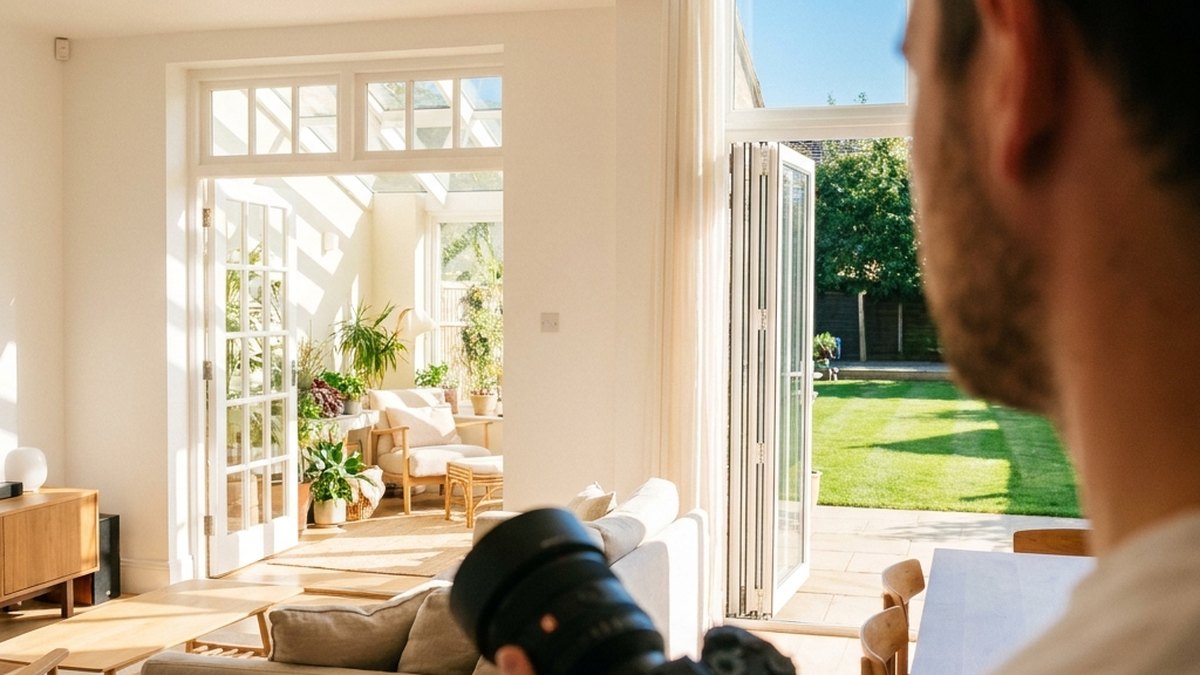
A walkthrough is not a virtual tour
A video walkthrough is a film. Someone presses play, watches sixty to ninety seconds, and either books a viewing or scrolls past. A virtual tour is different: it’s a space the viewer clicks through at their own pace, room by room, sometimes with a dollhouse view from above. Both have a place on a London listing. They are not the same product, and I get asked to swap one for the other more than any other mix-up in this job.
If you are buying one to start with, buy the film. It works on Rightmove, on Instagram, on WhatsApp when a buyer forwards it to a partner. A virtual tour needs a click and a bit of patience most casual browsers will not give it. I cover the 360 side properly in my piece on virtual tours for London listings — this article is about the filmed walkthrough only, cut as one moving piece rather than a clickable model.
The 90 seconds, second by second
This is the cut I deliver, timed out. It is what a finished piece of property work looks like once you break it into shots rather than watch it end to end.
| Second | Shot | How it is filmed | Why viewers leave here |
|---|---|---|---|
| 0–3 | Opening frame, the best room in the flat | Static or a slow push on a gimbal, exposed for the window | This is the frame that decides whether they keep watching |
| 3–8 | Wide establishing move through that room | Gimbal at chest height, walking at half speed | Too fast here and the room reads as small |
| 8–15 | Detail cutaway: a fireplace, a worktop, a view | Locked-off tripod shot, no movement | Breaks the walking rhythm before it gets tiring |
| 15–25 | Kitchen or second reception room | Gimbal, one continuous line through the space | Weak transitions between rooms lose people here |
| 25–40 | Second detail cutaway plus a light source | Static shot, ND filter on the window | A blown-out window reads as an unfinished edit |
| 40–55 | Main bedroom | Gimbal, single pass, no re-entry through the door | Re-entering a door mid-shot looks amateurish and people notice |
| 55–70 | Bathroom and any second bedroom, cut faster | Locked-off shots, three or four cuts | Interest is already dropping, so pace has to lift |
| 70–85 | Outdoor space or the street view | Handheld or gimbal, natural light only | Confirms the location before the close |
| 85–90 | Outro card: address, price, agent | Static graphic over the final frame | Gives someone the detail they need to act |
Notice the order. It is not the order you would walk through the flat on a viewing. It’s the order that keeps a thumb still.
How it is filmed
Everything moves on a gimbal, chest height, at roughly half the pace you would naturally walk. Zooming during a move looks amateurish on every screen size, so I do not do it. All the size change happens in the cut, not the lens.
The kit
- A gimbal-mounted body with a 24mm for the moving shots
- A locked-off tripod for cutaways and detail shots
- An ND filter, because a bright September window will blow out otherwise
- A small LED panel for a dark hallway or a windowless bathroom
Holding exposure
The hardest technical part is not the movement, it’s the light. A flat with a dark hallway and a south-facing lounge can be four stops apart. I ride exposure by hand through the move rather than trust auto-exposure, which hunts and pulses in a way that is obvious once you have seen it a few times.
Vertical, horizontal, or both
The listing page wants 16:9. Instagram, TikTok and most portal social feeds want 9:16. I shoot every walkthrough to work as both rather than picking one and cropping it badly afterwards.
A narrow Victorian terrace in somewhere like Walthamstow or Stoke Newington often films better vertically anyway. The hallway and stairs run tall and thin, and a horizontal frame wastes half its width on wall. A wide reception room in a converted warehouse flat goes the other way.
The export I hand back covers both without a second visit: one edit, two aspect ratios, cut so the framing works in each without clipping a head or a light fitting at the edge.
Music, captions and the agent to camera
Assume the sound is off. Most people watch property video on a bus or in a waiting room with the phone muted, so anything said aloud needs to also sit on screen.
Captions and music
I put the room name and its dimensions on screen as each space appears: kitchen and diner, 3.4m x 2.9m, that sort of thing. Music stays neutral and low. A track that’s too upbeat fights a serious £850,000 listing; one too moody undersells a bright first flat.
The agent to camera
A negotiator speaking to camera works when they know the property cold and can say something specific in fifteen seconds. It does not work as a script read off a phone in the hallway, which is most of what I am asked to film. If in doubt, leave it out. A flat with no presenter and good captions beats one with an awkward one every time.
What it costs and how long it takes
A walkthrough runs from £350 when it’s filmed on the same visit as the stills, alongside property photography from £180. Booking the two together is the sensible order. I am already in the flat, the light is already sorted, and there is no second trip to arrange around a tenant or a vendor.
For a typical two-bed flat, filming takes about an hour on site. The video walkthroughs from £350 come back edited within 48 hours, with one round of changes included.
Filming the video on a separate visit costs more than the film is worth. You are paying for a second call-out, a second window of the vendor’s time, and a second dose of London logistics: parking near a period conversion in Islington, or getting kit up in a lift that fits two people in Canary Wharf. I would turn that job down before I would quote it that way.
The first three seconds decide the whole film
Most walkthroughs open on the front door. I think that’s close to the worst possible choice, and it’s where roughly eight in ten of the walkthroughs I get sent as reference material begin.
The front door and the hallway are, in my experience, the two worst-looking parts of nearly every London flat. Narrow, often carpeted in something from 1994, lit by a single pendant. Opening there tells a viewer the film is going to be ordinary before it has shown them anything.
I open on the best room instead: the one with the light, the view, or the feature the listing is meant to be selling. Bedroom with the roof terrace. Kitchen with the exposed brick. Whatever it is, that’s frame one, not frame forty.
- Find the room that made you stop when you first walked the flat
- Check it faces good light at the time you are filming
- Open there, not at the address the buyer already has on screen
There is one property type where starting outside is right: a house with real kerb appeal, a period front or a garden square, where the exterior does genuine selling work rather than just confirming an address. For a flat inside a converted building, the exterior belongs to every other front door on the street too. Skip it.
Tell me the postcode and roughly when the flat will be ready to shoot, and I will book a walkthrough and confirm a slot within a working day.