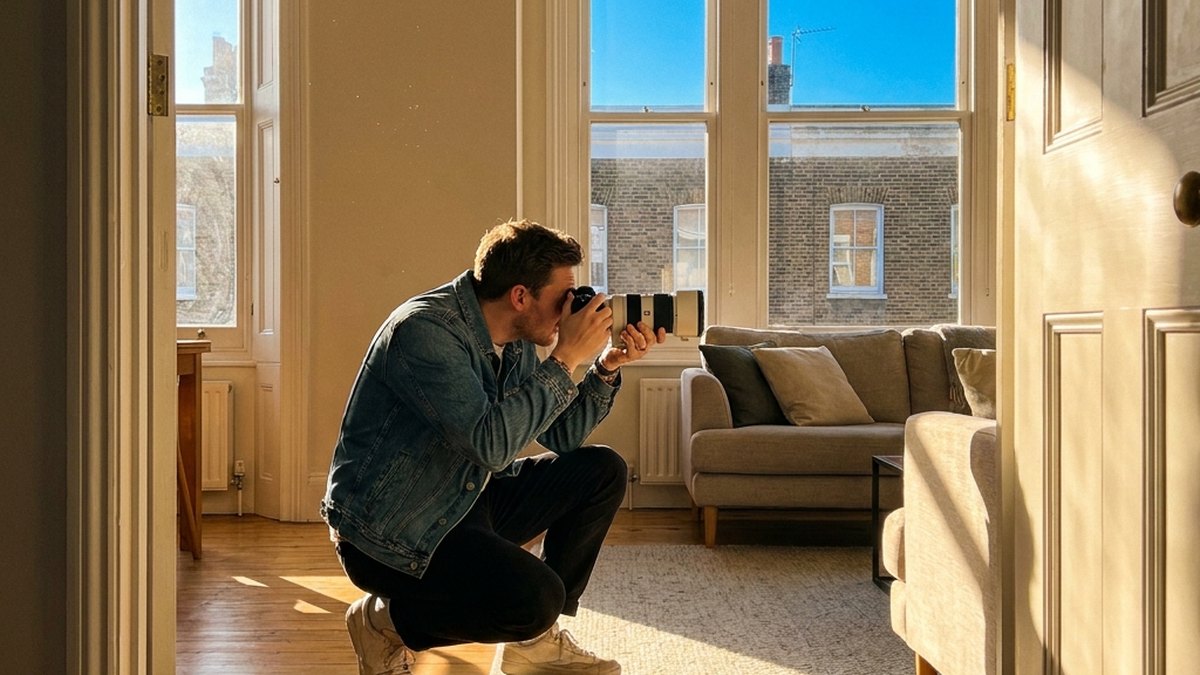
What the lead image actually has to do
A buyer on Rightmove or Zoopla is looking at a grid of thumbnails roughly the size of a credit card on a phone screen, each with a price under it. They are not evaluating your property. They are deciding, in well under a second, whether to tap. That is the whole job of the lead image: beat fourteen other properties in the same postcode at roughly the same price.
Which means it has to work small. Fine detail is wasted at that size. What reads in a thumbnail is brightness, one clear subject, a strong shape and a bit of colour. A dim, cluttered kitchen reads as a grey rectangle. A bright living room with a window at the far end reads as light and space, and light and space is what people are shopping for.
Everything after that is arithmetic. Taps become views, views become enquiries, enquiries become viewings, viewings become offers. Each step has its own conversion rate, and photography moves the very top of the funnel, which is the number all the other rates get multiplied by. That is why it is the cheapest lever on the whole listing.
Which photo should lead the listing
My default order for a London flat: best living space, kitchen, exterior or building, main bedroom, second bedroom, bathroom, outside space, the view, the street. Two exceptions come up constantly. If there is genuinely good outside space – a garden, a proper terrace – that leads between roughly April and September. If the building itself is the story, a stucco front, a canal-side warehouse, a Georgian terrace, the exterior leads all year.
Almost nothing else should. Not a bathroom, not a hallway, not a floor plan, not a bedroom with the bed pushed against a wall. I have seen listings led by a communal entrance because it felt like the honest thing to do. On an ex-local-authority block in Zone 2 that is a click you have thrown away before the buyer has seen a single room, and the flat inside may be the nicest one on the market that week.
What bad photographs cost
The table below is how I would spend a marketing budget on a sale listing, assuming the vendor has prepared the property first, because none of it works otherwise.
| Option | Typical cost | What it changes | Worth it when |
|---|---|---|---|
| Vendor’s phone photos | £0 | Dark rooms, leaning walls, blown windows; the listing reads as cheap whatever the asking price | Effectively never on a sale |
| Agent shooting on a compact | £0 | Brighter than a phone, but inconsistent room to room and no lead image strategy | Low-value lettings under time pressure |
| Professional set, 15-20 images | from £180 | Consistent exposure and colour, straight verticals, a lead image chosen to win the thumbnail | Every sale listing |
| Photo set plus floor plan | £180 plus £40-£70 | Buyers self-qualify on layout, so the viewings you do get are better attended | Every sale listing |
| Photo set plus twilight exterior | plus £75-£150 | One standout hero image at the front of the gallery | Houses, gardens, lit architecture, top of the street’s price range |
| Photo set plus walkthrough video | from £350 | Longer dwell time on the listing page, plus something usable on social and for overseas buyers | Higher-value sales, new-builds, unusual layouts |
Put the numbers next to the alternative. A price reduction on a £600,000 flat is rarely a token £5,000; in practice it tends to be three to five per cent, which is £18,000 to £30,000. Set against that, £180 for a full photo set is not really a cost decision at all. The expensive outcome is not the photography. It is the fourth week of a listing that launched badly.
What I do differently from a phone
Three things, mostly, and only one of them is about the camera.
The first is light. A living room on a grey Tuesday has maybe eight stops of range between the window and the corner behind the sofa, and a phone cannot hold both ends. I either bracket five exposures and blend them, or shoot an ambient frame plus a flash frame with the light bounced off the ceiling and blend those. The flambient approach holds truer colour than straight HDR and avoids the flat, grey, over-processed look you see on a lot of agency sets. The room stays bright and you can still see the garden through the glass.
Second is geometry. Walls should be vertical. A wide lens tipped downward makes a room lean inward like a ship going down, and buyers register that as wrong without being able to say why. I keep the camera level, shoot from around chest height rather than eye height so ceilings do not dominate, and correct what is left with tilt-shift or lens profiles.
Third is dull and probably the most valuable: consistency and file specs. Fifteen to twenty images, same white balance, same brightness, same crop ratio, so the gallery does not lurch between warm and cold as the buyer swipes. I export at around 2,000 pixels on the long edge, because the portals compress hard and a file sharpened for print falls apart at thumbnail size. And it all goes back within 24 hours, since agents launch on Thursdays and a set that arrives Friday has missed the week.
Where photography will not help
Photography does not fix a price. If a two-bed is on at £675,000 in a street where two-beds sell at £610,000, better pictures will bring more people to look at something they will not offer on, and you will burn through the listing’s first fortnight – the only fortnight in which portal alerts push it to every registered buyer in the area. That is worse than doing nothing, and I have watched it happen more than once.
Nor does it fix a 68-year lease, a ground-floor flat on a busy junction, a bedroom that is genuinely six square metres, or a kitchen that needs £30,000 spending on it. What good photography does is make sure the property is judged on what it actually is, rather than on a dark snap taken at 8pm in November. That is the claim, and I would not make a larger one.
Lettings work differently
On lettings, speed beats polish more often than anyone in my trade likes to admit. A one-bed in Zone 3 at £1,750 a month will go inside a week on a bright ten-image set and a floor plan. Spending £400 on video and a twilight exterior for that is money the landlord will never see back. Where lettings photography does earn its keep is the top end: a serviced flat in Canary Wharf, or a Mayfair let where corporate tenants are choosing from photographs alone, frequently from another country.
If it were my listing
With a fixed budget per listing, I would spend it in this order: a proper daytime photo set, a floor plan, a walkthrough video, then twilight, then drone. The first two belong on every listing. The rest are for properties where the marketing is genuinely doing the selling – a house with a garden, a new-build, something at the top of its street’s range.
I would also relaunch rather than quietly swap the images over. Portal alerts fire on a new listing, and a strong set going out to every registered buyer in the postcode is worth far more than the same set appearing silently on a listing that has been sitting there for six weeks.
Property photography starts at £180 with the edited set back inside 24 hours, and I add CAA-authorised drone where the plot or setting justifies it. If you run a branch in north London or anywhere else across the city, send me the address and your launch date.