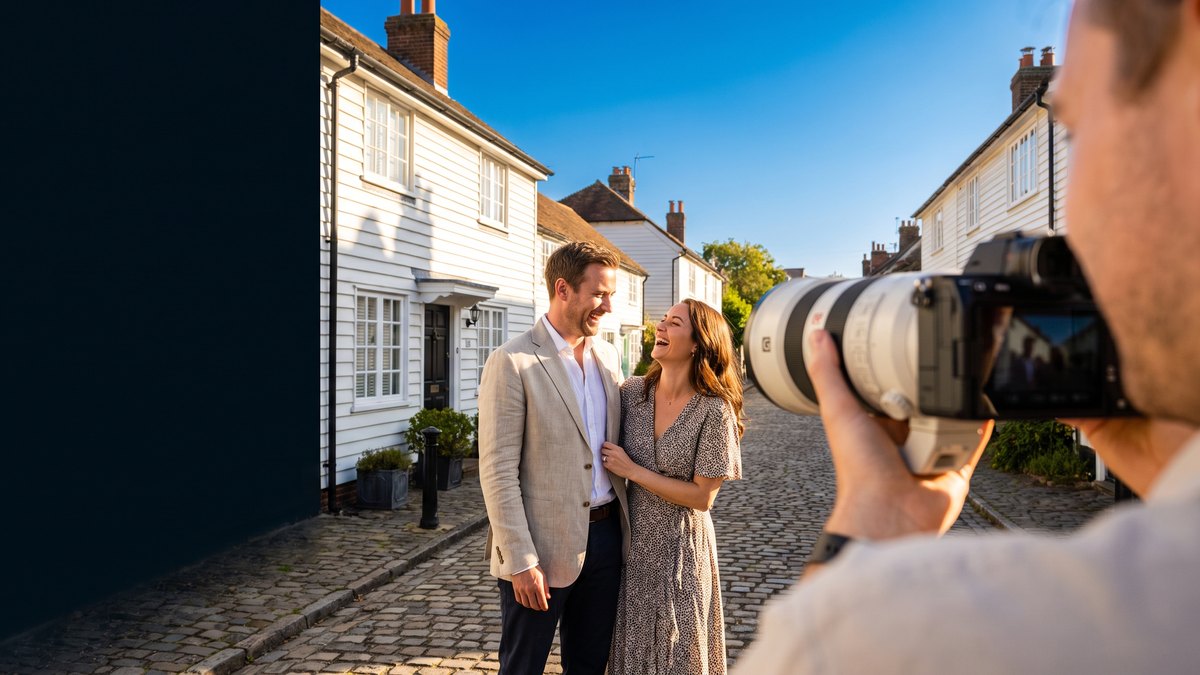
What a two-hour session actually produces
Honest numbers rather than package copy. A two-hour London session means two locations within a ten-minute walk of each other, one outfit change, somewhere between four and six hundred frames on the card, and sixty to ninety edited images delivered. Engagement galleries go back in about a week, which is far faster than the four to six weeks a full wedding takes, simply because there is a fraction of the material to work through.
| Session | Locations | Outfits | Edited images | What it realistically covers |
|---|---|---|---|---|
| 1 hour | One | One | 30–45 | A save-the-date, a couple of prints, and the practice |
| 2 hours | Two, close together | Two | 60–90 | The usual booking: two distinct looks and a proper warm-up |
| 3 hours | Two or three | Two | 110–150 | Sunrise starts, wider spread across the city, website material |
Standalone, expect £250 to £400 in London for one to two hours. Plenty of photographers, me included, fold a shorter session into a full-day wedding photography booking. If yours offers that, take it. The rapport is worth more than the pictures.
Direction that works on people who hate being photographed
Nobody can hold a pose and look relaxed at the same time. So I don’t ask for poses, I ask for tasks. Walk to that lamppost and back, slower than feels normal. Tell each other something the other one doesn’t know. Whisper something rude. Stand still, count to ten in your head, look at me on ten.
Hands are the giveaway. Give them a job: a coat over an arm, a coffee cup, a hand in a pocket, a thumb hooked through a belt loop. Movement covers stiffness better than any instruction, which is why half of what I shoot on these sessions is walking, fixing a collar, or laughing at something that has just gone wrong.
Distance helps too. A 70-200 from twenty metres across Greenwich Park lets the two of you have an actual conversation and forget I exist. Close-in work on a fast 35mm is fine once you have warmed up. Not in the first fifteen minutes.
The first fifteen minutes of every engagement shoot are rubbish, and a decade of experience has not fixed that. I plan around it. I start somewhere unremarkable, shoot frames I have no intention of delivering, and the usable material starts around minute twenty. Anyone promising you will feel comfortable straight away is describing a person you are not.
Time of day, and why I will push you towards a Tuesday
Golden hour is real and badly oversold. The hour before sunset gives low, warm, directional light that flatters almost everybody. The catch is the London calendar: in mid-June sunset is around 9.20pm, so a golden-hour shoot means starting at half past seven, and by late December it has gone by four. Both work. Neither is convenient.
Weekdays matter more than the exact hour. St Dunstan-in-the-East at 8am on a Wednesday is empty and beautiful. The same garden at 2pm on a Saturday has a queue for the archway, and I have stood in it behind two other couples. Columbia Road on any Sunday is a flower market rather than a location. If you can both take a half-day off, you get a different city for the same money.
Seasonal light in London, month by month
- January and February. Bare trees, flat soft light all day, sunset just before four. Locations are deserted. The least fashionable window and, honestly, the easiest one to book.
- March and April. Blossom at Kew and along the Greenwich avenues, plus a real chance of being rained off. Build a wet-weather plan before you book.
- May and June. Best greenery, worst crowds, latest starts. Beautiful and awkward to schedule.
- September and early October. My favourite window by a distance. Warm low sun, sunset around seven in mid-September, tourists thinning out, dry more often than not.
- November and December. Blue hour arrives at half past four, which suits Coal Drops Yard, Leadenhall Market and anywhere with warm window light. Cold hands show up in pictures, so bring gloves you don’t mind carrying.
Outfits, and the London problem of where to change
Two outfits is plenty. Three is a session spent in toilets. Coordinate rather than match, and I’d argue matching outfits have looked dated for about fifteen years; a couple in the identical shade of blue reads as a school photo.
Nowhere in a Royal Park is there anywhere to change. Plan it in advance: a café that knows you are coming, a gallery with decent facilities, a friend’s flat, or a first location near your own front door. Think about the ground as well. Leadenhall Market cobbles and a new pair of heels do not get along, and the Regent’s Canal towpath is muddy from October onwards. Bring trainers and swap them out for the frames that show feet.
Permits: the part nobody mentions until the week before
Here is where London gets fiddly. If you are being photographed by somebody you are paying, managed spaces treat it as commercial photography, whatever the pictures are for and however small the camera.
- The Royal Parks (Hyde Park, Kensington Gardens, Greenwich, Richmond, Regent’s, St James’s, Green Park, Bushy) require a licence for professional stills. Published rates for a small group have recently run from roughly £250 to £490 plus VAT depending on the park and the hours, you need £5m public liability cover, and they ask for a minimum of about ten working days to process it. Check current rates directly before you book, because they are reissued each year.
- Kew Gardens runs its own scheme. You book a photography permit on top of admission for everyone attending, it comes with time and area restrictions, and it covers the outdoor gardens only, not the glasshouses. Turning up on a standard ticket with a photographer in tow is not permitted.
- City of London open spaces such as St Dunstan-in-the-East and Hampstead Heath are not the free option people assume. The Square Mile gardens run a wedding and lifestyle photography licence at around £294 for up to two hours, and the Hill Garden and Pergola on Hampstead Heath is about £234 for two hours, weekdays only. Streets, canal towpaths and ordinary borough park land are the genuinely free choices.
- Private estates including King’s Cross, Battersea Power Station and Broadgate need permission from the estate team. Security do move people on, politely and firmly.
Plenty of photographers shoot the parks and hope. In ten years I have been asked to stop twice, both times in Greenwich, both times by someone perfectly reasonable who simply wanted to see a permit. It cost the couple half an hour of their session. Worth avoiding.
The session I’d book
Two hours, a weekday, mid-September, starting around half four. Two locations ten minutes apart with one outfit change between them, and I would pick streets and canal over a Royal Park purely to sidestep the permit and the fee. If money is tight, book one hour and drop the second outfit rather than dropping the shoot altogether, because the practice is the point. And if you are already easy in front of a camera, put the money towards an extra hour of coverage on the day or towards wedding videography instead. Nobody should sell you a session you don’t need.
If you want somewhere to start, the twelve London locations I actually use covers light, crowds and access for each one, and picking your photographer first is the step most couples take second, which I’ve written about in my guide to choosing a wedding photographer in London. For dates across East London and the rest of the city, a note on the contact page is enough to start, and replies go out inside one working day.