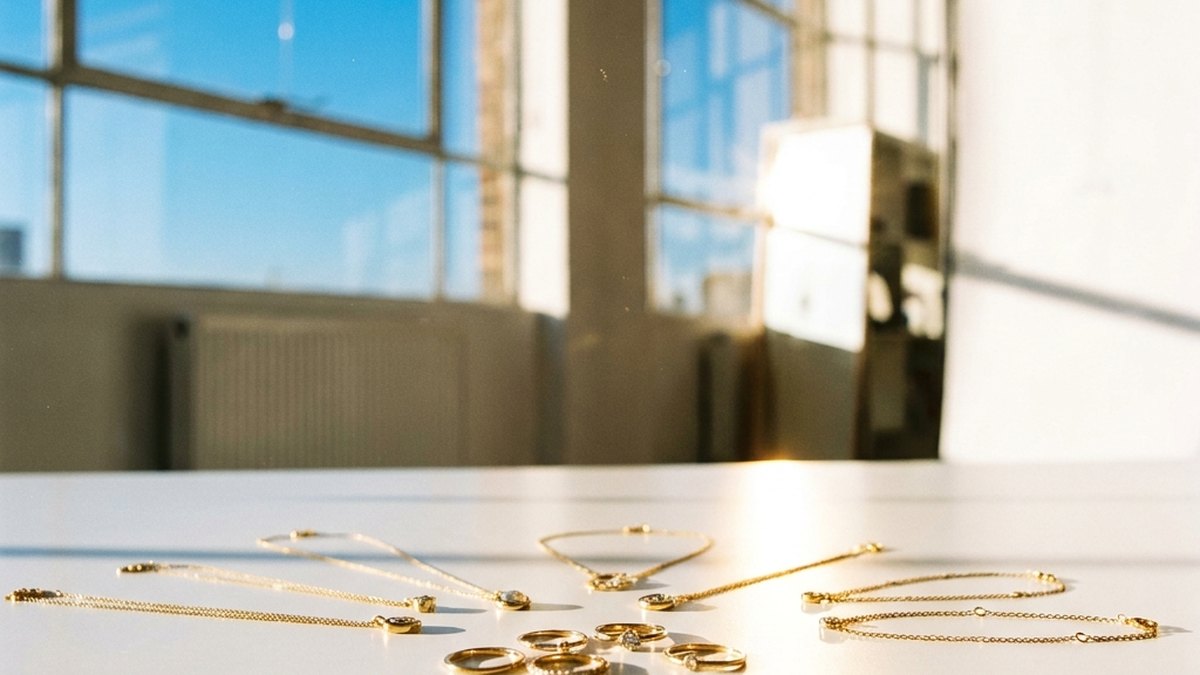
Why jewellery is slower than every other product
A 12mm ring shot close enough to fill the frame gives you a few millimetres of usable sharpness. Move the plane of focus half a centimetre and the shank goes soft while the stone stays crisp, or the other way round. On a candle or a shoe that barely registers. On a wedding band it’s the whole photograph.
Every polished surface in the room becomes part of the picture. Silver, white gold and a sapphire crystal on a watch face all reflect the studio, the lens, the tripod legs and whatever I’m wearing that day. A client who sells forty ring styles a week can tell rose gold from copper at a glance, and from a screengrab, not a print. That is the standard I shoot to.
Because of that I book six to ten pieces a day for jewellery, not the fifty-plus I would manage on a homeware or stationery job. Anyone quoting jewellery at the same day rate as flat-lay product work is either padding the timeline elsewhere or skipping the stacking. I’d rather say that upfront than have the conversation after delivery.
Reflections: the whole job in one word
Tenting and card
Most jewellery lighting is tenting. A diffusion cone or a light tent wraps the piece in soft, even white so a polished ring reflects sky rather than studio clutter. White card either side draws highlights back onto curved metal. Black card, held close to the edge of a band, pulls a dark line into the reflection so a round shape reads as round instead of flattening into a blob of light.
Filters and crossover
A polarising filter cuts glare off enamel and resin without killing the sparkle a diamond needs, which is a different problem to glassware, though the physics rhyme closely enough. I use much the same tenting and bounce approach on stemware and bottles, and it is worth reading how I light food and drink in London if the crossover interests you.
There is a specific moment on every jewellery job where I notice the lens, the tripod and my own sleeve staring back out of a pendant, three frames after I thought the set was clean. It happens on food and drink photography from £400 too, glassware behaves the same way, and it’s why I check reflections at full zoom before moving on rather than trusting the screen on the back of the camera.
Material by material
Different metals and stones fail in different ways, and each needs its own fix rather than one lighting set-up applied to everything on the tray.
| Piece or material | What goes wrong on camera | How I light it | Frames per finished image |
|---|---|---|---|
| High-polish silver | Mirrors the whole room, including me | Full tent, black card for edge definition | 25–30 |
| Brushed or matte gold | Reads flat and grey under soft light | Small flash bounced off white card for grain | 20–25 |
| Rose gold | Shifts pink or orange depending on white balance | Neutral tent light plus a grey card in frame one | 20–25 |
| Brilliant-cut diamonds | Fire and sparkle vanish under soft light | Small hard point light angled for flash off facets | 30–40 |
| Opaque stones (turquoise, opal) | Colour banding and dull surface texture | Raking side light to hold texture | 20 |
| Pearls | Blow out to plain white, lose lustre | Dimmer diffused light, gradient reflector for the sheen line | 20–25 |
| Enamel and resin | Hot spots and colour cast from glare | Polarising filter plus soft tent | 15–20 |
| Engraving and hallmarks | Too shallow to register at normal angles | Low raking light and a longer macro stack | 30–40 |
| Chains | Links overlap and lose separation | Pinned on a board, top light for individual link shadow | 15–20 |
| Watch faces under sapphire crystal | Crystal reflects the whole studio like a mirror | Tent with a lens-sized cut-out, shot square-on | 25–30 |
Watch faces and diamonds sit at the top of that list for a reason. Both need the most frames and the most patience, and both are where a rushed shoot shows first.
Focus stacking, in plain terms
I shoot jewellery on a 100mm macro at f/8 to f/11. That’s sharper than f/22, where diffraction softens fine detail even though the depth of field looks deeper on paper. Instead of chasing sharpness from one aperture, I take twenty to forty frames on a focusing rail or by stepping the lens electronically, each one focused a fraction further through the piece, then merge them in software.
The merge itself takes ten to fifteen minutes per image once the frames are captured, longer if there is engraving or a facet pattern the software struggles to blend cleanly. That sits on top of shoot time, which is why a day rate built for stacked jewellery looks nothing like a day rate for a single-frame product shot.
- Camera locked on a geared head, no handholding
- Continuous, colour-consistent light through the whole stack
- A physical sample within reach to check against the monitor
- Ten minutes of dust-off and lens cleaning before the stack starts
Done properly, this is how you get the kind of close-up and product work that holds up on printed A4 as well as it does on a phone screen, with the shank, the setting and the stone all sharp in the same frame.
Colour you can defend to the client
Every jewellery session opens with a colour checker card in the first frame, shot under the same light as the piece. That gives me a fixed reference to correct against rather than guessing from memory. My screen is calibrated monthly, which matters more on jewellery than almost anything else I shoot.
I keep the physical piece on the desk through editing too, not just for the shoot. Screens lie in small, consistent ways, and a rose gold band that looks warm and coppery on a calibrated monitor can shift cooler the moment it’s viewed on an uncalibrated phone in a shop, or printed in a catalogue on uncoated stock. No amount of retouching fixes a viewing device I do not control, and I say that before we start, not after someone complains.
Handling, insurance and getting the pieces back
Every piece gets logged on a signed handover sheet before the tray leaves the client’s hands: item, description, estimated value, time in, time out. I work in cotton gloves for anything with a polished finish, fingerprints show up brutally under macro light, and pieces go straight back into a locked case between set-ups rather than sitting loose on the bench.
My cover extends to goods in my care, which matters when a £4,000 ring is sitting on a set in a Hatton Garden studio, a rented space in Clerkenwell, or my own bench in Shoreditch rather than in a safe. Some makers stay in the room for the whole shoot regardless of the paperwork, and I would rather that than have someone anxious at home.
It’s often the moment a maker asks about branding photography from £600 for portraits and campaign shots to go alongside the product images, since they are already in the studio and dressed for it.
Focus stacking is not a luxury on jewellery
I would disagree with the advice, common enough online, that stacking is an optional extra reserved for pieces above a certain price. On jewellery specifically, a single frame at f/11 gives you one plane in focus and everything either side of it soft. For a ring, that usually means the stone or the shank is sharp, never both.
Calling that fine for a £2,000 piece and optional for a £200 one has never made sense to me; a macro lens doesn’t check the price tag before it decides how much is in focus.
There’s one case where I will shoot single-frame: flat items photographed dead-on, like a pendant lying face-up with no real depth, or a chain shown as a styled flat-lay rather than a close-up. There, f/11 covers the whole piece in one frame and stacking adds cost for nothing. I say so before I quote, and the client keeps the difference.
Post one piece to me for a test and tell me the metal, the stone and roughly how many pieces you need shot. I’ll come back with a price and a lit sample within one working day.