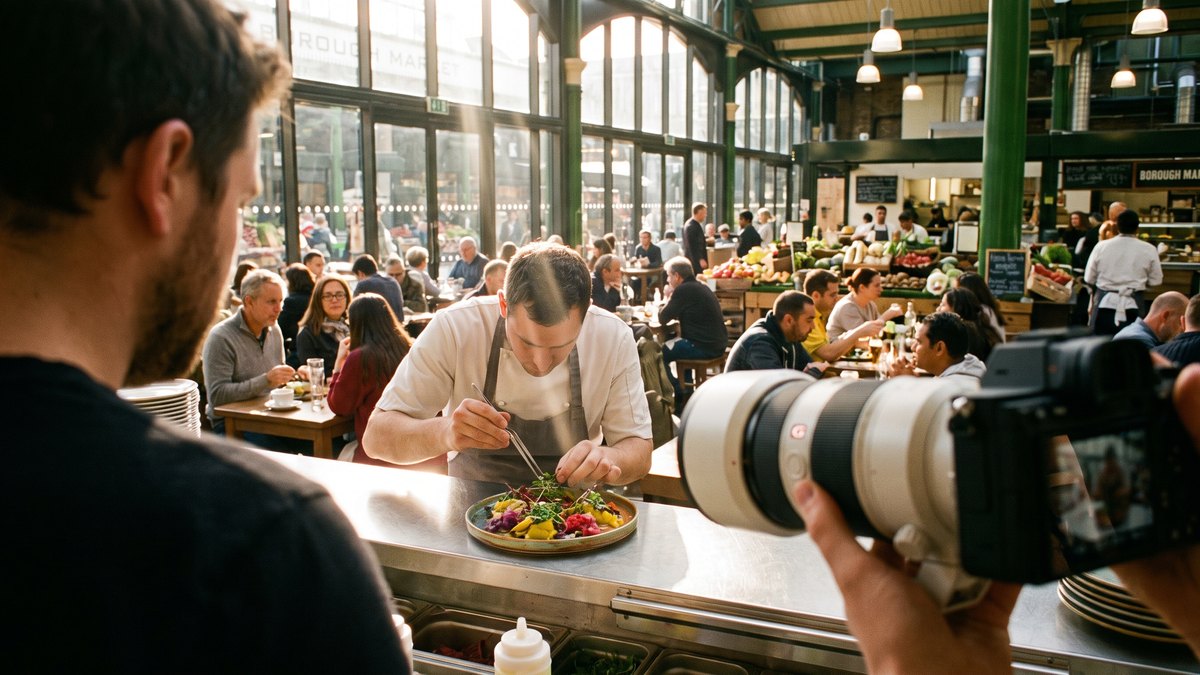
The first second is the whole game
Instagram decides very quickly whether to keep showing your clip, and viewers decide faster than that. If your reel opens with a wide shot of a doorway and a slow push-in, you have already lost most of the audience before the food appears. Start on the moment. Knife into the crust, the pour hitting the glass, the tongs lifting something out of the fryer.
I shoot the hook shot first and separately, usually two or three takes, tight and at 60 frames a second so it can be slowed without turning to mush. Everything else in the reel is supporting material. If the first second is weak, nothing after it gets seen.
The six formats worth your time
| Format | What it is | Effort | Best for |
|---|---|---|---|
| Hero dish close-up | One signature dish, tight, in motion, 6-10 seconds | Low | Steady weekly appetite content |
| Hook and reveal | Bold opening frame or claim, then the dish or room | Medium | Reaching people who do not follow you |
| The pass at service | Real kitchen, real speed, tickets and hands | Medium | Credibility and personality |
| Room filling up | Timelapse or handheld walk as the covers land | Low | Selling the evening, not the plate |
| New dish drop | Repeatable template for specials and launches | Low | Menu changes, seasonal pushes |
| Staff pick | One person, ten seconds, what they order on a day off | Low | Trust, and it travels locally |
The staff pick is the one restaurants underrate most. It is a phone, a person and a sentence, and it consistently outperforms things I have spent four hours lighting. The pass at service is the one that needs the most care, because a real kitchen at seven on a Friday is chaos and you cannot ask anyone to repeat anything. I shoot it from one fixed position with a fast 35mm, stay out of the walkway, and take whatever the evening gives me.
Notice what is missing from that table: dance trends, text-heavy explainers, and anything requiring a member of staff to lip-sync. They can work for a specific kind of account with a specific kind of personality behind it. For most London restaurants they eat an hour of everyone’s afternoon and produce a clip that ages badly.
Trending audio is a trap for restaurants
This is where I disagree with most social media advice. Business accounts on Instagram do not get access to the full commercial music library, so the trending track you heard on a personal account may simply not be available to you. If you use a workaround, the audio can be muted or the reel pulled later, taking its reach with it.
Beyond the licensing, trending audio dates a clip within about a fortnight. Restaurant content should be reusable. A dish close-up with clean sound design, the sizzle and the pour and the knife, still works eighteen months later and can be re-posted to Stories, put on your website, and handed to a delivery platform. I would take usable-forever over briefly-fashionable every time.
What you can film yourself, and what you should not
I am not going to pretend a restaurant needs a professional for everything. Some of the best performing content on hospitality accounts is a member of staff talking to a phone for eleven seconds. The line I would draw is roughly this: anything where the food itself has to look extraordinary needs lighting and a proper lens, and anything where a person is being human is better done cheaply and quickly by you.
Practically, that means bring someone in for the hero dish sequences, the kitchen pass, and the room at its best. Film the specials, the staff picks, the deliveries arriving and the dog that lives in the corner yourself. Mixing the two registers is not a compromise, it is what a real account looks like. A feed that is entirely polished reads as an advert, and people scroll past adverts.
One caveat on self-filming: clean your phone lens, and turn the overhead spots off if they are putting a hard white blob on the plate. Those two habits close most of the gap.
Captions, tags and the boring things that convert
Most people watch on mute, on a bus, one thumb away from leaving. So burn captions into the video rather than relying on auto-captions, name the dish on screen within the first two seconds, and put the neighbourhood in the text. “Shoreditch” in the caption does more for a local restaurant than any hashtag block.
- Location tag every single reel, and tag the neighbourhood in the caption too
- First line of the caption is a hook, not a greeting
- One clear next step: book, walk in, or link in bio to the menu
- Keep clips 7 to 15 seconds unless there is a genuine story to tell
- Post two to four times a week, at times you can actually sustain
How to get a month of reels out of one visit
Batching is the only sustainable approach for a kitchen. A four-hour session before service will comfortably produce eight to twelve reels plus stills, because the lights are already set, the chef is already plating and the room is empty. Trying to film reactively during a Friday night is how restaurants end up with six months of nothing.
A typical batching visit for me runs like this: 9am lighting and the first two hero dishes, 10am the kitchen pass sequence with the prep team, 11am drinks and dessert, midday room and detail shots as the light shifts. Everything gets shot vertical for reels and wide enough to crop 4:5 for the feed, so the same visit feeds both. If you are also refreshing your menu images, run the food photography on the same morning — the briefing guide covers how to structure that.
If the budget is small
If you have £600 to spend on video this quarter, I would not spend it on one polished brand film. I would spend it on a single restaurant videography session that gets you ten reels, then post them over ten weeks and film the lo-fi stuff yourself in between. A quiet feed hurts a restaurant far more than an occasionally scruffy one.
I would also stop worrying about production value beyond a point. Sharp focus on the food, decent light, clean sound, steady enough to watch. Beyond that, the returns fall off fast. The restaurants doing well on Instagram in London are not the ones with the best cameras. They are the ones that post.
Measuring whether it is working
Ignore views. Look at saves, shares and profile visits, in that order. A save means somebody is planning to come. A share means somebody is bringing a friend. Both correlate with covers in a way that view counts never have. Then check your Google Business Profile and booking system for the week after a strong reel rather than the day of — restaurant decisions run on a lag of several days.
If a format produces saves twice, keep it. If it produces views and nothing else three times running, drop it, however good it looked.
If you want a hand setting up a repeatable monthly rhythm rather than one-off filming, I run monthly content packages for hospitality across East London. Tell me what your kitchen can spare and I’ll be realistic about what it will produce. Drop me a message whenever suits.