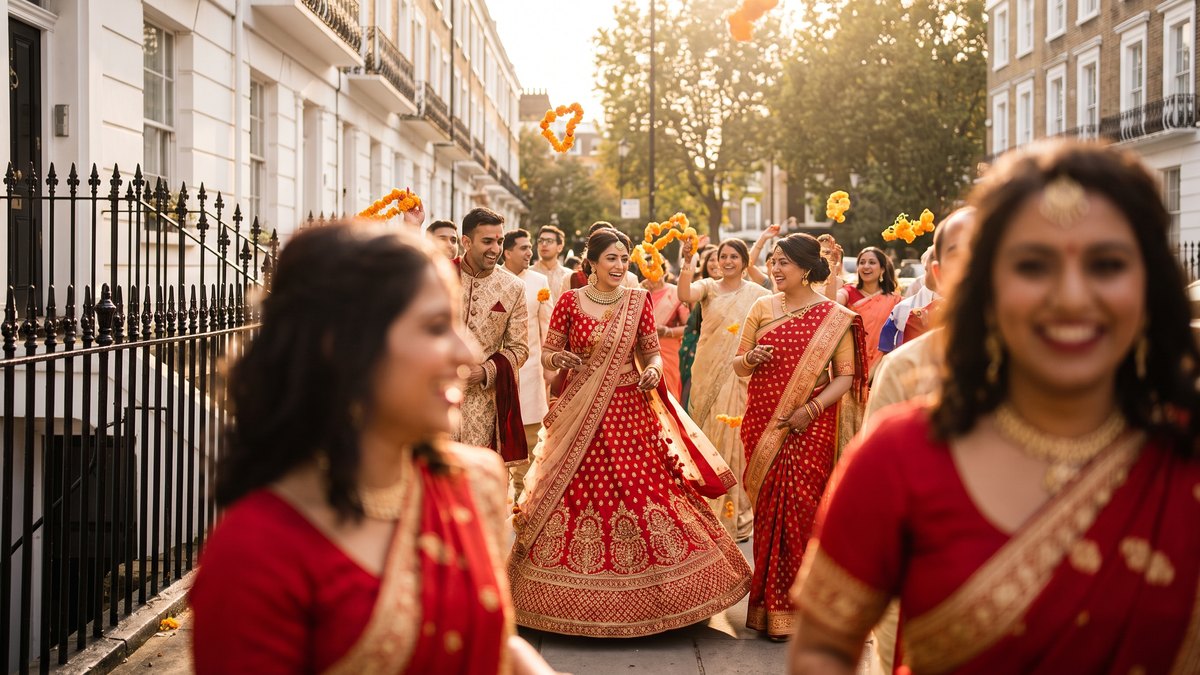
Four kinds of ceremony, four completely different days
The biggest mistake I see families make is assuming experience transfers. Someone who has shot forty North Indian Hindu weddings may never have covered a nikah or a Tamil Hindu muhurtham, and the skills only partly overlap. Ask to see one complete wedding in your own tradition, morning to last dance, rather than a highlights set.
North Indian Hindu ceremonies
The structure usually runs baraat, milni, ganesh puja, jaimala, kanyadaan, the pheras around the fire, then vidaai. The mandap is the practical constraint. It is a four-post structure, frequently set against a wall, so there is one working side and a priest whose back you will be shooting past for two hours. The havan fire throws haze, beautiful in a shaft of window light and quick to fog a front element if you sit too close. Vidaai is the emotional peak of the whole day and it happens fast, often outside next to a car.
Sikh ceremonies
The Anand Karaj is normally a morning event finishing with langar. The etiquette is not negotiable, and photographers who get it wrong are asked to leave. Heads covered, and I keep spare rumals in every bag because guests forget. Shoes off. No alcohol or tobacco anywhere on the premises, including in your kit bag. You sit on the floor, you do not point your feet towards the Guru Granth Sahib, and you never place yourself above it, which rules out stepladders, some balcony positions and any thought of a drone. The four laavan are the frames that matter most. Gurdwara halls mix daylight and old fluorescents, and flash during the ceremony is usually unwelcome, so this is fast-prime work at wide apertures and high ISO. Ask the granthi or the committee where you may stand before the day. The larger Southall and Ilford gurdwaras have written rules and a designated area.
Muslim ceremonies
The nikah itself is often far shorter than families expect, sometimes twenty to forty minutes, with the signing of the nikah nama as the frame you cannot miss. The walima may follow that evening or on a separate day. Two things need asking rather than assuming: whether the family wants segregated coverage with a female photographer for the women’s side, and what the sharing policy is. A good share of the Muslim weddings I have worked come with no social media use at all, and that belongs in the contract at booking, not in an awkward conversation afterwards.
Tamil Hindu ceremonies
Tamil Hindu weddings share the fire and the priest with North Indian Hindu ones, and almost nothing of the timing or the sound. The muhurtham is set by the family priest and is frequently very early. I have started at half past five in the morning in a hall in Wembley, which changes everything about how you staff the afternoon. The tying of the thaali is the single most important second of the wedding and it lasts about four. Nadaswaram and thavil at close range are loud enough that verbal direction is pointless, so agree hand signals with your second shooter before anyone picks up a camera.
Haldi and mehndi: colour, mess and mixed light
Haldi is turmeric paste and powder, thrown and smeared and enjoyed, usually in a garden or a marquee in daylight. Practical reality: rain cover on, an older zoom on the body going into the middle of it, and accept that something will need cleaning afterwards. The yellow bounces up onto faces and drags white balance warm. I let it stay warm. Correcting it out removes the entire point of the event.
Mehndi is the opposite problem. Evening, indoors, henna applied over several hours, so coverage is detail-led: cones, hands, the pattern building, and the family circle keeping the bride company for hours. It is usually the darkest event of the week and the one families most often cut to save money. I’d keep it and trim an hour off the reception instead.
Why one photographer is not enough
This is arithmetic, not an upsell. On a full wedding day things happen simultaneously. The baraat arrives with a dhol player at the front door while the bride is being finished upstairs. Two getting-ready addresses can be six miles and forty minutes apart on a Saturday. With four hundred guests, the family group shots alone run to ninety minutes, and while that is happening nobody is covering the room.
Then there is stamina. Fourteen hours holding a camera at head height in a hot hall is beyond one person’s concentration, and it shows in the final two hours, which happen to be the reception, the dancing and the send-off. I bring a second photographer as standard on these days, and a rotating third when a wedding runs across three or four events. On a smaller mehndi or haldi one is genuinely enough, and I would rather say so than sell you two.
| Event | Typical length | What I’d staff it with | The moment not to miss |
|---|---|---|---|
| Mehndi | 3–4 hours | One photographer | The finished pattern and the reaction to it |
| Haldi | 2–3 hours | One photographer | The first handful of turmeric |
| Sangeet | 4–5 hours | One photographer, one on video | Family performances and the faces watching them |
| Hindu ceremony or muhurtham | 3–5 hours | Two photographers | Baraat entrance, jaimala, the pheras or the thaali, vidaai |
| Anand Karaj | 2–3 hours | Two photographers | The four laavan, then langar |
| Nikah | 1–2 hours | One or two photographers | The signing of the nikah nama |
| Reception or walima | 5–6 hours | Two photographers | The entrance, the speeches, the first dance |
Working alongside a videographer
Photo and film either come from one team or from two suppliers who need to behave like one. Three things decide whether that goes well. Sightlines: agree before the ceremony who owns which side of the mandap and who has the aisle, because the alternative is both of you in each other’s frames all morning. Lighting: constant video lights change the colour of my stills, so we settle a temperature in advance rather than fighting over it. Sound: once radio mics are live, nobody is directing anyone out loud.
A same-day edit played at the reception is lovely and it costs something real: the editor needs four or five hours, a quiet room with power, and a runner ferrying cards back and forth. If that leaves the video team short-handed during the reception, I’d skip it and take the full film six to eight weeks later. My guide to wedding videographer costs in London goes through the numbers.
Venues, and London’s specific logistics
Most of this work happens in three kinds of building. Large hotel ballrooms around the Edgware Road and Park Lane, windowless, so it is artificial light from first frame to last. Community and banqueting halls in Wembley, Edmonton, Ilford and Harrow, where ceilings are often high, dark and useless for bouncing flash. And places of worship: the mandir in Neasden, the gurdwaras in Southall, Hounslow and Ilford, mosques across the city.
The practical costs nobody quotes for: crossing the Congestion Charge zone twice in a day, ULEZ, parking at a Wembley venue on a match day, and a 5am load-in with two bodies, four lenses and lighting stands. If your events are spread between West London and the east, build travel into the running order honestly. Sixty minutes on paper is ninety on the North Circular.
What to ask before you book
- Can I see one complete wedding in my tradition, from the morning through to the last dance?
- Who exactly is turning up, how many of them, and at which events?
- Have you shot in this specific gurdwara, mandir or mosque, and do you know its restrictions?
- Can you provide a female photographer for the parts of the day where that matters?
- What is your policy on sharing our images, and will it be written into the contract?
- How do you handle a 5am start and a 1am finish without the last hour falling apart?
My advice, unhedged
Two photographers on the main ceremony day, one on the mehndi and haldi, and video only if you are the kind of family who will sit down and watch it. If budget forces a choice, protect the ceremony and cut an hour from the reception rather than the reverse, because nobody rewatches the dancing as often as they expect to. Agree the image-sharing policy in writing at booking. And be sceptical of anyone quoting a flat day rate before they have asked how many guests are coming.
Costs for this work sit above a standard London wedding for obvious reasons, and I’ve broken the wider market down in my London wedding photography cost guide. If you would like a quote written against your actual running order rather than a package, send it over on the contact page, or have a look at how I approach wedding photography and wedding videography as one job.
If you have read this far and want the practical detail — packages, multi-day pricing and what a two- or three-day booking actually includes — see Asian wedding photography in London, or Asian wedding videography for the film side.