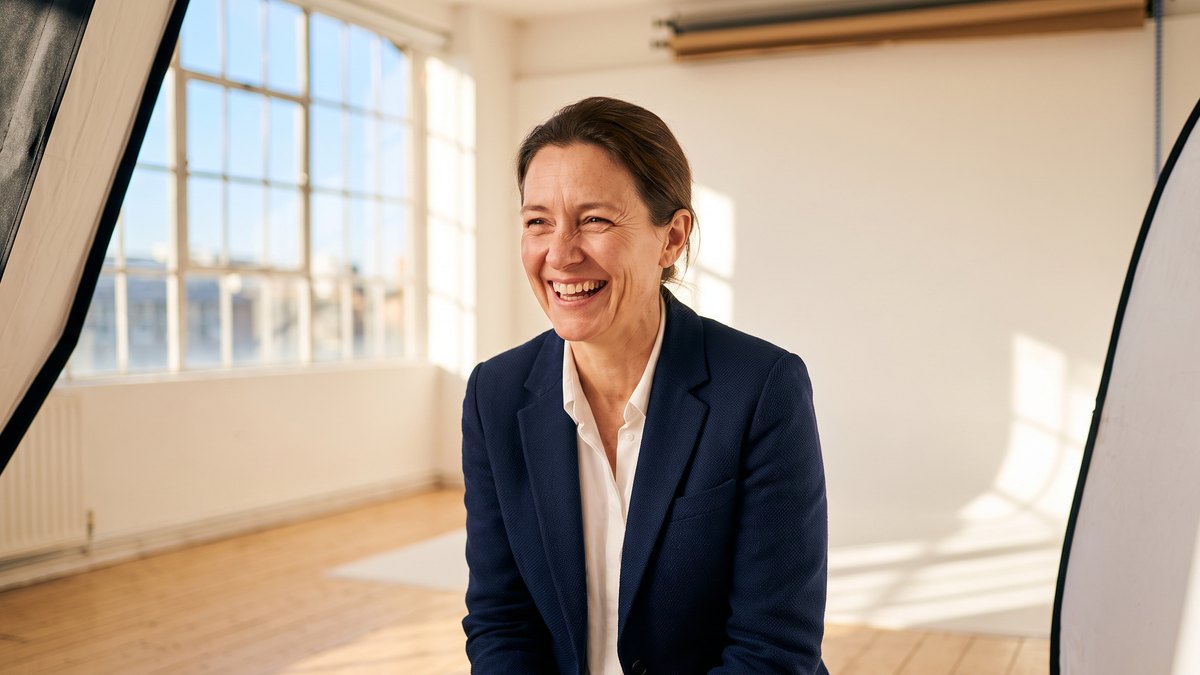
What happens to your headshot in a casting session
A casting director opens Spotlight, pulls up a breakdown, and scrolls a grid of forty or fifty thumbnails. Three seconds a face, sometimes less. A shortlist gets drawn before anyone opens a CV or checks your credits.
That is the whole game. The photograph isn’t there to flatter you or to look nice framed on a wall. It has one job: get you into the room. Everything else, mood, backdrop, a clever crop, is decoration nobody has time to notice at thumbnail size.
Which is why contrast matters more than polish. A headshot that reads clearly at postage-stamp size, with your eyes doing the work and your expression legible from across a room, beats a beautifully lit portrait that goes soft and grey the moment it shrinks. I’d rather shoot for the thumbnail than the print.
I’ve had actors turn up with a headshot from three agents ago, taken against a mottled studio backdrop that was already dated the year it was shot. Nothing wrong with the face in it. The picture just was not built for a grid of fifty rivals.
Bracket by bracket
Different casting brackets read a headshot differently, and a photo that lands for one can miss for another entirely. Actors starting out are often shot for a generic “actor headshot” rather than for the work they are chasing. A commercial headshot and a theatre headshot can come from the same session, but only if you know in advance which one you are prioritising on the day.
| What you go up for | What the headshot has to say | Wardrobe and framing | What kills it |
|---|---|---|---|
| TV drama, guest or recurring role | You could carry a scene of dialogue, not merely look the part | Plain top, no logos, close crop at eye height | A face styled as a type rather than a person |
| Continuing drama | You look like you live on this street, not like you are auditioning | Everyday clothes, muted colour, nothing that dates the shot | Anything glossy or magazine-lit |
| Commercials | Open, likeable, easy to cast against a product | Bright tone, a hint of a smile, clean background | A face that looks like it is already selling something |
| Theatre | Presence and stillness, a face that reads from the back row too | Simple dark or neutral top, no pattern | Retouched skin that will not match stage light |
| Comedy | Warmth with a glint of timing, not a held grin | Relaxed collar, an expression that could hold a punchline | A smile held so long it looks posed |
| Period | Bone structure and stillness that could sit in another century | No modern logos or jewellery, simple hair | A modern haircut or piercing left in shot |
| Corporate and training film | Approachable and competent, someone a viewer trusts on screen | Smart-casual, plain colour, no stage make-up | A look styled for theatre rather than camera close-up |
| Presenting | Direct eye contact and energy, someone happy holding a camera’s gaze | Solid colour, minimal jewellery, nothing that strobes | A headshot that looks posed rather than spoken to |
| Student and short film | Enough range in one face for a director to imagine three scenes | Whatever you would actually wear to set | A headshot that only works for one narrow part |
None of this means shooting nine different headshots. It means knowing which two or three brackets you are being seen for before you book a sitting, and framing the shoot around those. For the actual clothes and colours to bring, there is a separate guide on what to wear for a headshot; the table above is about what each bracket is listening for, not a shopping list.
The conventions that have not changed
Colour, not black and white. Eyes about a third down the frame. A crop from mid-chest up. One large soft light source, or open shade outdoors, so the shadows sit gently rather than carving your face into two halves. Sharp eyes above almost everything else.
What still holds
The crop and eye position are non-negotiable, because casting software and Spotlight thumbnails are built around them. Miss the framing and your face sits oddly in every grid it lands in, however good the photograph is underneath. This isn’t a matter of taste, and it is not about looking corporate or safe. It is about giving a casting director nothing to squint at.
What’s just fashion
Heavy desaturated grading, hard directional light and moody backgrounds come and go every few years. I would not chase them. A grade that dates in eighteen months is not doing you any favours when you are meant to reshoot every two to three years, not every awards season.
Two looks, and what the second one is for
One look should be neutral and castable: the face a casting director can drop into almost any bracket without a second thought. The second leans into the work you actually get called for, warmer and more open for comedy, more contained for drama.
Change one thing between the two: a shirt, hair down instead of up, a shift in expression. Not the location, not the light, not your whole manner. A recent client kept one look buttoned to the collar for period work, the second open-necked for comedy call-ins. A third look usually dilutes both of the first two rather than adding anything new, and I will say so if a client asks for one.
If you are after a wider set of portraits for a personal website rather than just Spotlight, that is a different job, closer to branding photography from £600, not an extra look bolted onto a headshot sitting.
Where to shoot in London
A north-facing wall in Shoreditch gives flat, even light for most of the day without the shadows a south-facing spot throws by midday. A park under flat cloud works too; Vauxhall Park on an overcast October morning is one of my regular fallbacks.
Studio, near Dalston Kingsland, when it rains, or in February when daylight is thin and grey by four in the afternoon. Hard midday sun is the actual enemy here: it carves harsh shadows under the brow and nose that no amount of retouching fixes cleanly.
A 45-minute sitting outdoors needs a plan B within a two-minute walk, a doorway, a covered arcade near Liverpool Street, anywhere with even light, because London weather does not hold a booking for you. September light goes by seven in the evening, so a late afternoon booking outdoors needs a hard finish time, not a loose one. Some of the calmest results I have had came from portraits shot in London daylight under exactly that kind of cloud.
Price, frequency and what you get
Expect £150 to £250 for a sitting of 30 to 60 minutes, with three to five retouched images at the end of it. That is headshot photography from £150, and it doesn’t move much whatever bracket you are being shot for.
What’s in the sitting
- Two looks, one change of shirt or hair between them
- Three to five retouched images, not the full unretouched set
- Files sized for Spotlight and for print, delivered separately
- Delivery within 48 hours
When to reshoot
Every two to three years as a rule, sooner if your hair, weight or general look has genuinely changed. A headshot that no longer matches the person who walks into the room does you more harm than an outdated haircut ever did in the photo itself.
Stop shooting three looks when one is true
Drama school leavers get sold four-look packages more than anyone else, usually right when they have got the least spare cash and the most pressure to look “industry ready” on every front. I think it is the wrong advice at the wrong moment.
One honest, well-lit, current photograph does more for a new graduate than four polished ones that all say slightly different things about who you are. Casting directors aren’t comparing your looks against each other. They are deciding, in three seconds, whether to open your profile at all.
Where more than two looks genuinely earns its keep: an actor working across sharply different brackets, say continuing drama and period, where one photograph cannot credibly do both jobs. That is a real reason to book a third. “Just in case” isn’t, and no amount of styling makes it one.
Tell me the date, the postcode and which brackets you are shooting for, and book a sitting. I’ll come back to you within one working day.